Things Left Unsaid

Things Left Unsaid
Nokyoung Xayasane

If she were honest with herself, it hadn’t turned out how she hoped it would. Her expectations had gotten the better of her. 

Sam stood leaning against the kitchen counter. She had thrown the pregnancy test into the trash before Eric got home from class. There had been a part of her that had hoped the test would be positive and another part of her, a larger more looming part, that prayed the opposite. She was no longer a religious person but praying seemed to be the best route. Please, she had prayed. I’m not ready. Maybe someday but not today.

If the test had been positive she knows her mom would be happy. Mai would be a grandmother like many of her friends whose kids hadn’t kept going on and on with more and more schooling. What’s with all the schooling, she’d say. What is it you’re learning exactly? 

The owl eyes of her teapot and cups stared back at her. The sink was empty of dishes but she had to get used to not having a dishwasher. Washing the dishes was like taking a shower—her thoughts wandered and vaulted here and there as the soap suds dispersed. Shower thoughts. Dishwashing thoughts. 

“Everything good?” Eric asked her while he held the refrigerator door open, scanning the contents for an after-class snack. Sam was still slightly amazed and annoyed at how quickly Eric had lost weight ever since he decided to cut out beer and processed meat from his diet. He shed the pounds like it was nothing. A preening heron on the edge of the water, regal and distant. 

He had come from a divorced home where his mom, an eccentric novelist, filled his plates with her latest concoctions of gluten-free, cauliflower-crust pizzas and meatless nuggets. He seemed to have gained weight in an act of rebellion. But now that he wasn’t under her iron apron, rebelling through food wasn’t as high a priority. 

Eric had lived with his mom and his aunt Celeste, a professional volunteer. She hadn’t been paid for any of her work, but she loved giving of her time as a museum guide or food tour guide. She also volunteered at the homeless shelter. Sam refrained from correcting her and saying “unhoused.” It was around the time of Eleanor’s first swipe at a novel that she adopted a cat and named him Kevin. Subsequently, John, Alfred, and Pam followed. Sam found the human names endearing, but still got confused when Eleanor would talk about Pam’s latest poop or Kevin’s finicky eating habits. They were Eric’s siblings. Round, rotund, purring.

“Yeah, I’m good. How was class?”

“Like every other day. I hardly talk to anyone. It feels like I only use my voice when I get home.”

The thing that had drawn Sam to Eric was their conversations. He would play devil’s advocate and it would get her all worked up. How could he defend bestiality? Easily. He spoke in a reasonable tone, hardly ever raised his voice, and listened, really listened. He never reacted. It was a dance, a collaboration of thoughts and ideas. She fell in love, not with his ideas, but how he presented them. She could put their conversations on mute and just watch his hands and face, extrapolating, reaching, and then finding solid ground. To not be able to do that everyday must really bother him.

“You haven’t made any friends?”

“No, not really.”

Eric was the kind of person who made his friends in grade school and just stuck with those same people. Ever since they had moved to Toronto, he would visit them as often as he could over the weekends. It was as if his real life were back with them and this life with her was a interlude until he could be with them again.

“Speaking of chatting: I had coffee with Padma today.”

“Oh, nice. How’s she doing?”

“She’s good. She talks a mile a minute. She seems like she has all these thoughts rolling around in her head and she needs to get them out as soon as possible. I find her kind of intimidating. I feel like I need to take a nap to recover.”

Eric smiled. 

Padma lived close to them on St Clair and Bathurst. Eric and Sam had chosen St Clair and Dufferin because his friend from Kitchener had moved to Toronto before them and lived close by. His friends were still a signpost for him even in apartment hunting. Padma was also from Kitchener, a university friend of Sam’s. Someone highly intelligent and heavily involved in politics and the social sphere. If there was a left-leaning protest, Padma was there. Sam found her passion energizing and then eventually exhausting. Sam preferred quiet activities like poetry readings and conversations in dimly lit rooms. She was a writer herself. A poet. Not something most people would understand given all the science courses she had taken throughout her schooling. But words drew her in. If there was a stanza that rang true and painful, she was there. It was a door opening. She held her breath and walked through.

“I was wondering. You wouldn’t mind if I had a chat with her, would you?”

Eric had been thinking lately about going to law school even though he was currently enrolled in lab tech courses at York University. That was also a reason why they lived at Dufferin and St Clair. 

“No, of course not. I think she’ll be able to answer a lot of your questions. Give you a better idea of what being a lawyer’s actually like.”

Padma’s career as a criminal defense lawyer kept her busy. In all seriousness, Sam couldn’t see Eric as a lawyer. He was more of a collaborator, artistic. From what Padma had said about her work, it seemed like it was every lawyer for themselves.

“Yeah, I think so, too.” He paused. “You sure you’re okay?”

Sam smiled. “Yeah, just tired.”

“Right. You need a nap to recover.”

“The introvert’s life.”

For some reason, years later Sam remembers how she talked about Padma that day. She had said Padma had intimidated her. In her eyes, it made her sound weak and fragile. In a position of disadvantage, in a state of admiration, almost. She wonders how Eric remembers it. Perhaps he took note of it silently, unconsciously. Perhaps it allowed them to stand beside each other and be compared without his knowledge or theirs.

There was a time, Sam thinks, when they were happy. It wasn’t as if they were unhappy—just kind of settled, in a certain routine. Eric got bored easily which may explain why they had moved three times in the last three years, almost every year, and for some reason, usually during the winter months, the worst time to move. But he always had help from his friends and bandmates. Being in a band was as if you belonged to a club whose members belonged to a larger club of other musicians. It was kind of like the nod that bikers give each other as they ride by or runners who raise their hand in greeting to another runner in passing.

“I don’t really think about it,” Eric said. Sam tries to remember what she had asked him. It was something along the lines of, “Do you ever think about tomorrow?” Or something less flowery and more pragmatic. 

“I don’t really think about it.”

“Maybe that’s the problem.” She had said this softly and in a non-accusing tone. She had never brought up the pregnancy test to him. Eric, who never really thought about tomorrow. Except when it came to potentially becoming a lawyer? Perhaps that was only a glitch that can be seen from a distance when time has passed. A character oversight that only makes sense later on.

Eric had been the first to move out. He had found a place quickly and with two friends she had never heard of before. She was staying until the end of their lease. Two weeks in the empty apartment and then she was moving uptown to Yonge and Eglinton with her university friend Candace.

But until he had found a place, they lived together for two weeks after deciding to end it. Sam was in a state of mourning and they were both in denial. They acted as if nothing had happened. They were bidding their time and wanted to staunch the wound before it bled out. And the best way to do that was to pretend like they were still together. At first they had tried not touching each other, even in passing between the kitchen and living room, but that seemed strange. They made a decision to act normal, whatever that meant. It was a form of self-preservation. A form of self-inflicted insanity. 

They went to the movies together. It was an outdoor film festival at Christie Pits. Sam looked at the screen. Moving figures and ricocheting sounds bouncing off the nearby houses and buildings. A dark world lit up by one small screen. Lives were unfolding with cinematic precision, one cut moving on to the next, self-assured and self-propelling. The score rising and falling, now hushed, barely a whisper, hardly a sound. She looked around her and saw the blue light of the film reflecting off people’s faces. Eric looked up and away, mesmerized. She reached her hand out and grabbed onto nothing, just empty air.

Notes on a partnership

Notes on a partnership
Nokyoung Xayasane

I write down notes
for my novel
and you jot down scenes
for your screenplay
while sitting in a cafe.
I prefer the quiet of the house,
the occasional sound of
the air conditioner turning on.

There’s no talk
between us
of what we’re writing.
No shop talk.
A silent demarcation
between Church and State.
We discuss feeding schedules
for our cat, a new duvet cover,
and if our friends are happy
or alcoholics or somewhere
in between.
Will they find love
or will they find purpose,
a new job,
a baby on the way.

Two writers in one household.
Both alike in temperance.
Afterwards, I’m usually
the first to apologize.
Your face softens with relief,
our laughter ringing out.

I walk from the living room
to the balcony
gazing gently over greenery.
I see you down on the street
walking briskly,
your stride recognizable to me
from any distance.
I see you as someone separate
from me, a person
making their way to the cafe
and my heart swells.
With what?
Something I can’t name.
Is it love or a thought
half remembered, a profound truth
hidden and waiting.
Is it a memory
of loneliness,
a memory of a time before you
of frenzied typing
and staring into space,
a pain in the chest
or is it a vision
of a time after you,
arthritic hands
weaving a story
white hair blowing
from the air conditioning.

I’ll walk from the living room
and onto the balcony
look down onto the street
and remember a gait
I could recognize
anywhere.
I’ll remember
your atrocious handwriting
and your look
that says, I understand.
I’ll remember
our laughter
ringing out.

What do I do with all this love I have for you?

What do I do with all this love I have for you?
Nokyoung Xayasane

You’re standing in front of an open window, billowing curtains. The winter sun shining in and you turned to me, your back against the light. Stained glass window. Your back against the light. Reds and oranges and yellows and blues and greens, playing across the curtains and your face.

That evening, early morning actually, I awoke and found the indentation of your body in the bed beside me. For a moment I felt fear, a pinprick straight to the heart.

I found you standing beside the window again, the darkness before the rising sun, a dim world encased in the quiet pre-dawn sky. I was relieved to see you standing there, still there. I stood beside you and you turned to me.

“You can’t stop thinking about her.”

“I wish I could, but I can’t.” 

We’re no longer hiding from each other, we’re beyond that. I’m relieved to see you still here; I thought maybe the worst had happened—that you had done the worst to yourself. I can’t help myself and reach out for your hand to make sure you’re still there, alive and breathing, short tortured breaths like a wounded animal.

“You love her.”

“I wish I didn’t, but I do.”

You have so many wishes right now. Wishing you didn’t, wishing you could. A world of wishes. I’m still riding the wave of relief to see you safely beside me, my pain at the fringes of it, the foam of pain on this wave of relief, keeping me afloat.

“You want to be with her.”

“Yes,” you say simply. No more wishes—just a statement of fact. 

“What do I do with all this love I have for you?” I ask you.

“I’m sorry,” you say. The dark sky behind you. Your back against the darkness.

“You should leave before she wakes up.” Our daughter asleep in the other room. “If you don’t do it now, you’ll never do it.”

“I’m sorry,” you say again.

I see you now, walking away from the window, away from the house, down the road to our car, the headlights streak across the road. The headlights turn, casting beams of long light and then you’re gone. 

What do I do with all this love I have for you? I write these words to you across space and time, making my way back to you. I love you. Nothing and no one has changed that. 

You in technicolour, the white of the curtains, and moving shapes of colour across your face. 

Late Afternoons on Air

Late Afternoons on Air
Nokyoung Xayasane

Here she was, waiting for him. She tried to see herself as others would. A woman, sitting at the bar, nursing a mocktail enhanced by an egg-white substitute. The bartender said it was made of peas, a vegan alternative. The vegan part didn’t do that much for her but she wanted to taste something different, a different texture, whilst drinking her slightly less expensive mocktail—some type of texture or flavour, something, anything.

She had arrived an hour late because of transit and yet he still wasn’t here yet. Traffic, he had said in his text. It made her feel better that she hadn’t been on time, waiting here for him, the minutes ticking away until an hour had passed by. She too was living her own life, busy enough and not-well-planned enough, to be a full hour late, and yet he had surpassed her here, still. 

It was a trait he had. Did he swoop in and out? Or was that how she saw him? What are our ideas of people but mere fabrications, small slivers of who they really are, snapshots in time, solidified in glass, unchanging, unwavering even in the face of evidence to the contrary.

She sipped on her vegan mocktail and imagined sipping on warm tea brewed in his mom’s kitchen, from his mom’s teapot.

“Unfortunately,” he said, “I can’t find the teapot.”

“Hmmm,” she said. “If I were a teapot where would I be?”

“It’s not in the kitchen,” he said.

She thought for a moment. And then made her way to his mom’s bedroom. She grabbed the teapot from her bedside table. “Found it!”

She smiled. She had been so young. And now, a middle-aged woman with fleeting, moored memories from 16 years ago. Tea was the precursor before their podcast recording sessions. Edwin had come up with it for their university’s literary magazine. Co-hosts before everyone and their cousin had a podcast. At the time, it was new to her, almost nerdy, an old world, voices drifting on the air, unattached to bodies, ethereal. Little did she know, ephemeral would’ve been a better way to describe it. Short-lived, fleeting. But never gone.

They brewed the tea and brought it downstairs to the basement, into a room with a glassed door. His podcast station. She had never really participated in collaborative creative projects before. She was a poet who wrote solely on her own, for herself. Having someone read or hear her work seemed unimaginable, yet here she was, in their first podcast session, about to record her own voice. 

She smiles now at the way he helped her feel at ease like a good director would—just natural conversation to take her mind off the recording. You felt at ease in his presence, safe. He was the teacher at school who believed in you despite what everyone else thought. He saw you.

One time he had said she was rare.

“If there was a graph that represented people,” he said. “There would be a cluster here in the lower left half. That’s everyone. And one lone dot in the upper right. All by itself. That’s you.”

She had scrunched up her face, unable to believe but wanting to, wanting to believe.

“An outlier,” he said. “You’re an outlier.”

Someone calling her rare. Well, you could say that was the beginning, and she hadn’t even known. Like she said, she was young, she hardly knew anything about life.

After the recording session, they went into the basement living space, past his bedroom. Light from the late afternoon filled the room, long bands of orange lasering their way to the brown couch. She doesn’t remember why or how but he sat on the couch and she on the floor, probably she felt comfortable there. And she rested her head on her arms which lay across the couch. She sat almost at his feet. The imagery. She chuckles now. What did they talk about? It seemed—everything. He was someone who was curious about everything, but mostly the arts and philosophy. An academic, really. Who wanted to remain in the ivory tower. Although this would change soon enough. 

He would record his session later, and after their tea break, they would record the intro and outro. Later on, she would listen to that first podcast, over and over again. Her voice heavy with emotion as she read her poem. Their intro and outro, alive, like live wire. She felt like she needed to walk around her neighbourhood after that first listen, her voice on air, his voice on air, late afternoons on air. 

Whatever happened to them afterwards, they existed there, frozen in time, floating on sound, wavelengths encased in time, unchanging, the beginning of something. They were on the verge of something. What it was she couldn’t name. But she felt it. 

The door to the bar opened. The light of the late afternoon streamed in, bands of light across the mahogany of the bar.

He stepped in and scanned the room for her. An hour late. He raised his arms into the air, wingspan like a great bird, the initial movements before a great embrace—a gesture she loved. His smile, open mouthed and unabashed. She basked in his warm glow. She was sitting at his feet in his mom’s basement. “Something’s never change,” she whispered.

“What?” he asked, his arms still outstretched.

She walked towards him and entered his embrace, engulfed in his embrace. “Nothing,” she said.

every day

every day
Nokyoung Xayasane

not in exotic locales do I love you
but at home, I love you

I turn the leaf of a page and you’re playing video games, mute on
the couch sighs beside the humming air purifier, the daily air quality warnings
we check the weather app and it says moderate
so we sit on the balcony that will always overlook the park, a view untarnished

music plays nearby, acoustic guitar and falsetto tones
and the quiet sounds of the street, cars and trucks stopping and going, air brakes, and bird chatter

I write poems in my Notes app about here and now and not there and the past
about where we are and not where we’ve been
Maybe I think about where we’ll go but not seriously and only languidly only barely

The long weekend beckons and
I say to you, It’s you; you’re the one
I say it in earnest and not as a joke, something new and pure
The long weekend and this long life
made short and fleeting
unrolling like a map where I close my eyes and place my fingertip down
Here, right here
I open my eyes to see where my finger has landed and
it’s where I’m supposed to be

I love you
the quiet, everyday of you
the quiet everyday of you
I love you

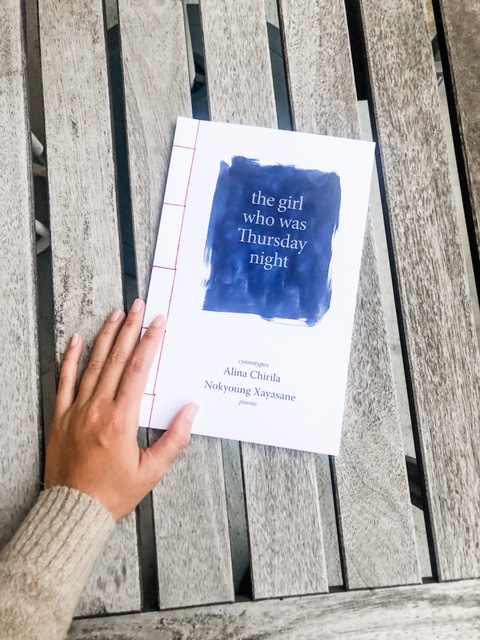
the girl who was Thursday night

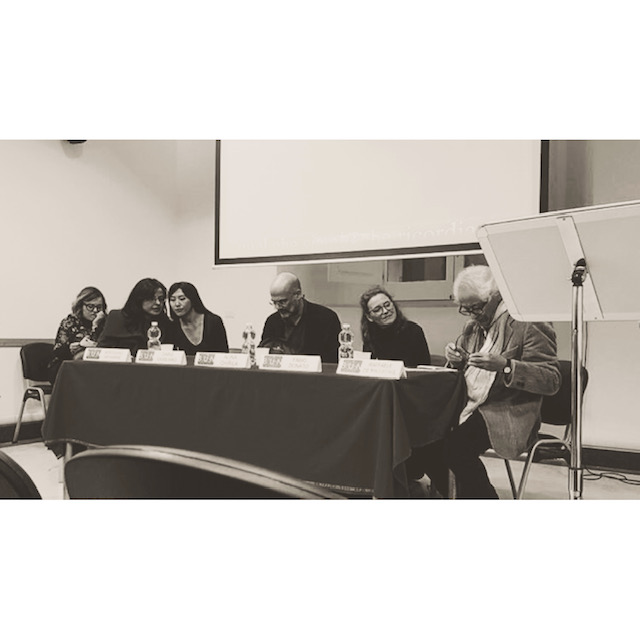
It’s finally here! My second book of poetry, the girl who was Thursday night, has arrived! And it’s in English. The first publication of the book was translated into Italian for the launch at the University Library of Naples, which was in November of 2019. We’ll have a Canadian launch very soon! Please stay tuned. If you would like to order a copy or have any questions, please send me a message below.


Go back

Your message has been sent

Warning
Warning
Warning
Warning.

Where the world began and ended

Where the world began and ended
Nokyoung Xayasane

There were these branches that reached up into the sky,
arms uplifted into the sun that I would climb.

There was that ease of a summer day,
the hot breath of the wind, a heat and a blanket on the grass.

I was there, walking along the asphalt underbelly of the bridge,
the train above me on some journey somewhere far from here.

I wondered where it was going, I wondered if one day
I would know its destination.

The sidewalk came up and met my sandalled feet,
and even then I dreamed and even then I did not know to want.

I was a blink of someone’s eye, I was a laugh ringing out,
I was the running of hands along a chain link fence.

It was there where I learned to ask unanswerable questions,
and to ache for tastes and fragrances and sounds,

for things and places that I did not know had names.
It was there where I learned where the world began and where the world ended.

a memory in time

it was safe to let you go
Nokyoung Xayasane

You were standing by an open window,
your hand on the frame.
You were looking out onto the street,
the curtain billowing.
No witness but me.
You were walking in the afternoon sun,
just a memory in time.

And that memory of you,
it was safe to hold on to it.

I was standing by the subway door,
my hand on the frame.
I was looking out onto the street,
blurs of colours, yellow and blue.
No witness but you.
I was walking in the afternoon sun,
just a memory in time.

And that memory of me,
it was safe to hold on to it.

We were running down cobbled streets,
our laughter
like a thousand stars
exploding
in the sky.
No witness but us.
We were walking in the afternoon sun,
just a memory in time.

And that memory of us,
it was safe to hold on to it.

Somewhere you are laughing,
your hands moving though the air.
Somewhere you are running,
your legs blurred and strong.

I am smiling,
my face lit up, bright and free.
I am running,
my breath long and deep.

The curtains shift,
and you are standing there by the window.
I did love you,
but you knew that.
Nothing
and no one
changes that.

The doors open,
and I am standing by the subway opening.
I reach out for your hand,
your hand across space and time.
I feel the pressure of your palm
against mine.

I am walking along the subway platform,
my legs moving, my breath steady.
I see the opening of the subway exit,
and I make my way towards it.
And that memory of you,
it was safe
to let you go,
and that memory of me,
it was safe
to let me go.

Somewhere I am emerging
into the afternoon sun.
I am walking slowly
along the streets without you.
And that memory of us,
it was safe
to let us go.

Idleness is a gift

main concept
Nokyoung Xayasane

Idleness is a gift
you give yourself,
I say
with a glass of rosé
in hand.

I want to write a poem
about justice and love and revolution,
you know,
those grand, unfathomable concepts.

Main concept: person, place, or thing.
Sub concept: politics.
But then I think
that poem is for someone else,
you know,
the spoken word artists
and the singer-songwriters
that hide power and the ties that bind
in their lyrics
about a late afternoon in Prague.

I want to write about Europe,
baroque architecture, grand sweeping phrases,
glittered and coating the balustrade of a golden staircase.

Main concept: person, place, or thing.
Sub concept: culture.
I wonder
if I don’t write about Berlin or London,
will it matter?
Locations don’t really move me
I find.
I have no feelings of sentimentality
for a broken wall someone else climbed over,
the steps of a museum where someone else
walked up and saw the afternoon light
bathing a dark haired man
who would become their lover, their enemy.

What I have is this—
Main concept: person, place, or thing.
Sub concept: boredom.
What are we but bored people
reaching out to each other?
Not even the drama of heartache
or treachery—betrayal—
no, just plain boredom.
And so I write nothing.
I feel neutral.
All signs pointing to a healthy mind
and an idle pen.
It’s the gift I give myself.

to feel something

to feel something
Nokyoung Xayasane

In the evening,
about around 8:30pm,
the sky transforms
into a landscape of pink,
touching the walled buildings,
blushing the trees billowing
in the summer heat.

The AC clicks on,
a swirling sound like the rivets
of steel of the subway tunnel,
the sound of something falling down the stairs,
a swirling wake in Hanlan’s Point.

There’s the pink sky in the evening
that purples into night fall,
that blooms into light
peeking and chirping with bird calls.

There’s this place, this street,
walking down Yonge
that hugs and presses against my skin,
the embrace of life and noise and sound,
the sound of giving up
and the sound of going on.

The morning reaches into the sky
following the line of a crane
hoisting a metal crate,
the building blocks of a condo
a skyscraper a home a business.

I said out loud, to no one in particular,
“I want to feel something
like really feel something.
Don’t you?”

And the sky and the trees, the birds,
they answered my call,
and they breathed and they laughed
and they whispered,
“Yes, I do. And I have. And you will, too.”

And the sky changed shape and coloured pink
reaching out to the edges of the city,
touching the cracks in the pavement
where a man and his dog sit
with a cardboard sign.
A man in a cowboy hat stands in front of the Chipotle
and watches passersby.

I want to feel something
like really feel something.
Don’t you?