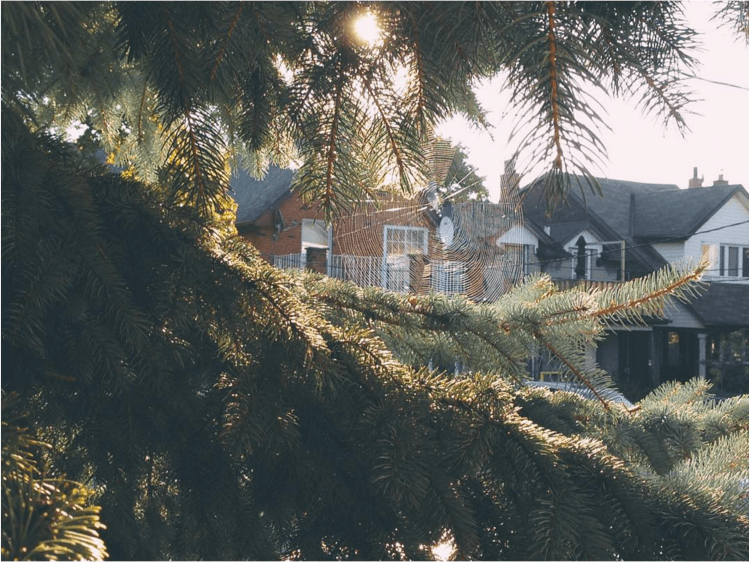
cobweb in the sunshine and the last Sunday I sat on this particular porch
What we talk about when we talk about love
Nokyoung Xayasane
I think I miss laughter the most.
I miss laughter, induced by another person,
or should I be more specific?
Induced by you.
Sitting on our front porch,
there were those tinkering wind chimes
our neighbour hung that annoyed you
but charmed me.
Do you remember them?
We sat in the comfort of each other,
reading and not speaking
while the hushed streets barely
whispered in the summer wind.
I miss the ease with which you live
your life,
the lazy energy of Saturday morning,
when there was time to say nothing
and do very little.
Sometimes I would look over at you
and I would try and remember
the sunlight streaming through the evergreen tree
beside our porch,
and I could barely contain myself for joy.
I miss the lazy car rides where I didn’t
have to talk and you didn’t have to listen.
We shared a silence
that only two people can share
who have said all they have to say
and need not say one word more.
Yes, I do,
I do, miss the easy laughter,
and I miss those lazy summer nights
when we were young and free
and full of something we could not name.
This morning,
riding back to our old neighbourhood,
I realized I missed
the wide-eyed enchantment
of things to come,
not knowing what was next for us.
Do you miss those things too?
I wonder,
but am too afraid to ask.
The man beside me on the streetcar
murmurs something incoherent
and I miss the ease of not missing you.
I know I can return
but I can never go back
to that place we shared
where laughter came easy
and the days were sweet and pure
and full of possibilities.
Do you remember that place
as I remember it?
I guess missing is all we have.
Those memories we shared from long ago,
they become as audible
as our old neighbour’s wind chimes
and as bright as the light streaming
through the evergreen trees
where two people read in the hush of summer.
And I realize far too late,
this must be what we talk about
when we talk about love.
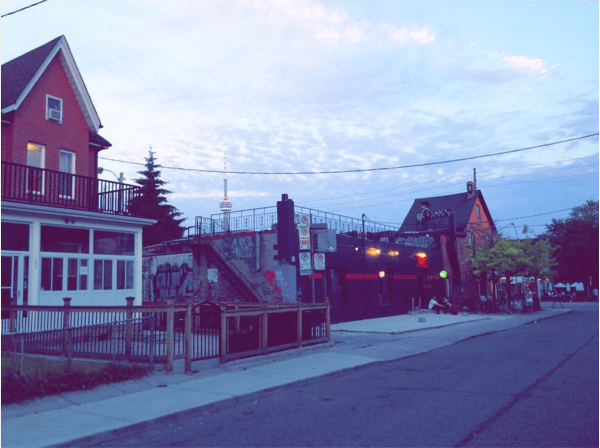
The last lights of summer (Little Italy, Toronto, August, 2015)
whatever it is we remember, we’ll remember this
Nokyoung Xayasane
whatever it is we remember
we’ll remember this
that once we were happy
and we held on to some sort of belief
in something beyond our bedroom walls
we once strained against the glass
that looked out onto the world
and we hoped for magical nights
when the air was warm but the wind was cool
when we gathered with friends underneath Christmas lights
that sparkled
even though it wasn’t Christmas
whatever it is we remember
we’ll remember a time
when we were young and beautiful
the world bowed to us
everything was possible, attainable
everything could be measured by the span of our hands
we held the world in our palms and
swung high into the air
the stars pushed out above
the songs from our childhood
our singing was no longer a form of helplessness
we remembered that once we knew nothing
and we still don’t
at least, at least
we are no longer afraid
at least we are full of wonder still
and the lights that glittered on that patio
that night
in that city we called home
we remember we loved and were loved
and all of it meant something
if only for a little while
if only for a brief moment
and we’ll remember nights
when time was within our grasp
but we lost it all the same
we spoke in fake British accents
in 24-hour phở restaurants
we held on to some kind of freedom
that was fleeting but we held on nonetheless
what we know now is this:
we’ll always be okay
we are sometimes surprised when
we hear our voices lifted above the tumult of noises
the traffic careening down streets that led to places
we thought we would never see
but stepping out into the street the wind lifts
our hair sticks to our lips
our bodies are nothing more than
air and dust and bone and breath
what we are we know
this will always last for us
what we know is time will stand still for us
but we wander nonetheless
we wander nonetheless
I am always hungry
& wanting to have
sex. This is a fact.
If you get right
down to it the new
unprocessed peanut
butter is no damn
good & you should
buy it in a jar as
always in the
largest supermarket
you know. And
I am an enemy
of change, as
you know. All
the things I
embrace as new
are in
fact old things,
re-released: swimming,
the sensation of
being dirty in
body and mind
summer as a
time to do
nothing and make
no money. Prayer
as a last re-
sort. Pleasure
as a means,
and then a
means again
with no ends
in sight. I am
absolutely in opposition
to all kinds of
goals. I have
no desire to know
where this, anything
is getting me.
When the water
boils I get
a cup of tea.
Accidentally I
read all the
works of Proust.
It was summer
I was there
so was he. I
write because
I would like
to be used for
years after
my death. Not
only my body
will be compost
but the thoughts
I left during
my life. During
my life I was
a woman with
hazel eyes. Out
the window
is a crooked
silo. Parts
of your
body I think
of as stripes
which I have
learned to
love along. We
swim naked
in ponds &
I write be-
hind your
back. My thoughts
about you are
not exactly
forbidden, but
exalted because
they are useless,
not intended
to get you
because I have
you & you love
me. It’s more
like a playground
where I play
with my reflection
of you until
you come back
and into the
real you I
get to sink
my teeth. With
you I know how
to relax. &
so I work
behind your
back. Which
is lovely.
Nature
is out of control
you tell me &
that’s what’s so
good about
it. I’m immoderately
in love with you,
knocked out by
all your new
white hair
why shouldn’t
something
I have always
known be the
very best there
is. I love
you from my
childhood,
starting back
there when
one day was
just like the
rest, random
growth and
breezes, constant
love, a sand-
wich in the
middle of
day,
a tiny step
in the vastly
conventional
path of
the Sun. I
squint. I
wink. I
take the
ride.
Hello, dear friends. I know it’s been a while since my last post — almost a year. Sometimes we have to wander a little bit before we come back to what we know and love. In my case, my truest loves are poetry and music.
Bluffer’s Beach in August, 2014
Since we last spoke, I moved to Toronto and I’ve been living here for nine months now, but I feel like I’ve always been here; this place has been a part of me before I even looked out my apartment window on St. Clair Ave.
The people, the voices of friends calling to each other, the cacophony of blaring horns, screeching tires, music playing in the streets, the way the afternoon sun punches through the clouds, the hush of a September morning, and the smell of fresh rain; these things I will always remember.
I was walking down St. Clair Ave West and Dufferin St, when I realized there’s only one thing I want now. It isn’t happiness, wealth, fame, or even peace of mind. What I really want is this: I want a life that is real.
Happiness Susan Griffin
Happiness. I am not used
to this. (There is always
something wrong.)
Look at it
the bright early tree.
(I am trying to find out
how you fell.)
The leaves have already turned.
(I want you to see
this, how they
glow outside the glass.)
Morning light strikes
differently. For so
many years I hardly
had time to know such
moments. They struck me
with such intensity
I would have said
battered me open.
I never understood
they were mine.
I was panicked.
Unhappiness caught up with me
all the time.
Did you know
the speed of light never alters
even when you go faster
it will be
still that much faster
than you?
(I am thinking that in your fall
something momentous occurred.)
What I see as beautiful
I want you to see too.
Next door, the workmen are hammering.
Very soon we’ll go to lunch.
For some reason this moves me to tears.
How life is.
(One does not have to explain
what occurs. One only need say
it has meaning.)
Years ago, when I was young
I traveled to Italy, took in
the great sights. I was in awe, yet
I did not understand
seeing Masaccio’s frescoes
fading like shadows into the walls,
this would be the only time
nor that
I would never forget.
Those muted shades are
still with me, as possession
and longing, and the view too
of the square before that church
the air, newly spring,
that day, all of it.
Life, I have finally begun to realize,
is real.
(All this time you recover
from falling
will sink indelibly into mind.)
The leaves
may fall before you are able
to see them. Science
has recently learned
the line
of existence is soft
and stretches out like a field
wind and light shaping the grass
energy
of sight giving consciousness
force. In the meantime
we live out our lives.
(This morning we talked for so long
everything became lucid.
How can I say what I see?)
At each turning
perfection eludes me.
One moment is not like another.
Last spring
the house next door caught fire.
There was the smell of gas.
We thought
both houses would go.
I vanished up the hill,
went to the house of a friend
where we listened for flames
and to that aria from Italian
opera, was it the one of love,
or jealousy, or grief?
My house was untouched.
Now the one next door is painted,
fixed. In place of
perfection, the empty hands
I turned out to the world
are filled.
With what? A letter
half written, the notes
I make on this page,
this new feeling about my shoulders
of age, that sad child’s story
you told me this morning,
the workmen’s tools sounding
and stopping. What? As time
moves through me, does it also
move through you?
I keep remembering what you said,
ways you have of seeing (and that
light must have curved with
you fall.) This
is the paradox of vision:
Sharp perception softens
our existence in the world.
I’m Lao but I was born in a Thai refugee camp. Here I am hanging out with my buddies and listening to our favourite cassettes. (Photo credit: nokxayasane/Instagram)
Happy Thanksgiving to all my lovely (Canadian) readers!
I know, I know, if you’re American, Thanksgiving’s not for another month or so. But that doesn’t mean you can’t celebrate with your neighbours from the North, right?
Mmmm, Thanksgiving. I wish I could share my homemade pumpkin pies with all of you. It may be the best pumpkin pie in existence. I’m not exaggerating. Or biased, whatsoever.
Pumpkin pies and baked goodies aren’t the only things I’m thankful for though. I’m thankful for a whole lot and when I sat down to think about my gratitude list, I felt almost overwhelmed but really happy.
It made me think: Many of the things we’re thankful for are shaped by where we come from and when we were born. I’m Lao but I was born in a Thai refugee camp. My parents and I immigrated to Canada when I was five years old. Sometimes it blows my mind to know I could’ve led a very different life.
But I also realized how similar we all are even with our diverse backgrounds and varying value systems. It’s a wonderful feeling to sit across from someone who seems so different from me — only to learn we both have a soft spot for Boyz II Men and would prefer to spend our Friday evenings cuddling with our tabby cats.
It’s also a wonderful thing to be able to connect with people I’ve never met and may never meet. Today marks two years since I began Bird of Passage! I’m thankful for this sense of community and for having a platform to share my love of poetry and music.
With that being said, I hope you enjoy this poem by Barbara Ras which sheds light on all the little and big things we may forget to be thankful for. Happy Thanksgiving, friends!
You Can’t Have It All, Barbara Ras
But you can have the fig tree and its fat leaves like clown hands
gloved with green. You can have the touch of a single eleven-
   year-old finger
on your cheek, waking you at one a.m. to say the hamster is back.
You can have the purr of the cat and the soulful look
of the black dog, the look that says, If I could I would bite
every sorrow until it fled, and when it is August,
you can have it August and abundantly so. You can have love,
though often it will be mysterious, like the white foam
that bubbles up at the top of the bean pot over the red kidneys
until you realize foam’s twin is blood.
You can have the skin at the center between a man’s legs,
so solid, so doll-like. You can have the life of the mind,
glowing occasionally in priestly vestments, never admitting
   pettiness,
never stooping to bribe the sullen guard who’ll tell you
all roads narrow at the border.
You can speak a foreign language, sometimes,
and it can mean something. You can visit the marker on the
   grave
where your father wept openly. You can’t bring back the dead,
but you can have the words forgive and forget hold hands
as if they meant to spend a lifetime together. And you can be
   grateful
for makeup, the way it kisses your face, half spice, half amnesia,
   grateful
for Mozart, his many notes racing one another towards joy,
   for towels
sucking up the drops on your clean skin, and for deeper thirsts,
for passion fruit, for saliva. You can have the dream,
the dream of Egypt, the horses of Egypt and you riding in the
   hot sand.
You can have your grandfather sitting on the side of your bed,
at least for a while, you can have clouds and letters, the leaping
of distances, and Indian food with yellow sauce like sunrise.
You can't count on grace to pick you out of a crowd
but here is your friend to teach you how to high jump,
how to throw yourself over the bar, backwards,
until you learn about love, about sweet surrender,
and here are periwinkles, buses that kneel, farms in the mind
as real as Africa. And when adulthood fails you,
you can still summon the memory of the black swan on the pond
of your childhood, the rye bread with peanut butter and bananas
your grandmother gave you while the rest of the family slept.
There is the voice you can still summon at will, like your mother’s,
it will always whisper, you can’t have it all,
but there is this.
Ras, Barbara. “You Can’t Have It All.”She Walks in Beauty. Ed. Caroline Kennedy. New York: Hyperion, 2011.
dance floors would bleed from the knife of her dress (Photo credit: nokxayasane/Instagram)
When you start a new chapter in your life, you can get super stressed out.
Whether you’ve decided to move to a new city, take on a new job, or end a toxic relationship, there’s always a sense of fear that comes with your decision.
But fear shouldn’t be something we … well … fear. It’s the thrill of knowing our life, as we know it, is about to change, drastically.
Yes, there will be times when we’re lost on the metro and have no clue where we’re going and we ask ourselves why we’ve moved to a city of faceless strangers. Yes, there will be days when our new boss is micromanaging the sanity out of us and we’re dying for the clock to read 5 pm. And yes, there will be days when we wish for the comfort of our former partner even though the relationship was as dysfunctional as Hannah and Adam’s relationship in the first season of Girls.
For me, whenever I start a new chapter in my life, I try and find poetry that comforts me and validates my decisions.
This is an excerpt I took from Dionne Brand’s book of poetry called Thirsty. I chose the parts I liked best so it’s missing a bunch of the poem.
To read the whole poem, check out her book. Do people still buy books nowadays? I hope so. Books are the bees’ knees.
XXXI, Dionne Brand
the clarity
of the traffic, the sky, the day, her life
her directions, plain, unknown, except for this,
the idea, the idea that she was possible
she could assassinate streets with her eyes
damage books and chemical compounds and honey and waiting
rooms, dance floors would bleed from the knife of her dress
She needed to smell, without dying, the skin
of someone else, she needed without wounding,
without a murder, without a killing, a truce if not peace,
a city, as a city was supposed to be, forgetful,
and to gather up any charm she might have
left, to sleep, to feel snow, to have it matter,
to wake the leaves, to hate rain
Heads up!
I’m starting a new lifestyle blog in the new year which chronicles my adventures as a freelance writer trying to make it in the big city (Toronto) with the help of food, friends, and feline. Stay tuned!
We all know working isn’t the greatest. When you’re paid to do something, it makes the job less magical.
On the other hand, there’s nothing more attractive than being around hardworking people. It’s like I kinda hope their passion and work ethic will rub off on me. They inspire me to stop watching reruns of TheHills, get off the couch and get working.
I’m trying a new thing now. Or I’m trying to try a new thing. I’m looking to do work I’m truly passionate about.
There are all kinds of reasons to pursue a specific career and many of them are obvious and can’t be ignored (examples: paying rent to keep from being homeless, buying groceries to keep from starving), but when all that’s taken care of, you’re left with the “why.” Why am I working so hard at a job I’m not passionate about?
It’s a question we should ask ourselves before our mid-life crisis rolls around.
To be of use, Marge Piercy
The people I love the best
jump into work head first
without dallying in the shallows
and swim off with sure strokes almost out of sight.
They seem to become natives of that element,
the black sleek heads of seals
bouncing like half-submerged balls.
I love people who harness themselves, an ox to a heavy cart,
who pull like water buffalo, with massive patience,
who strain in the mud and the muck to move things forward,
who do what has to be done, again and again.
I want to be with people who submerge
in the task, who go into the fields to harvest
and work in a row and pass the bags along,
who are not parlor generals and field deserters
but move in a common rhythm
when the food must come in or the fire be put out.
The work of the world is common as mud.
Botched, it smears the hands, crumbles to dust.
But the thing worth doing well done
has a shape that satisfies, clean and evident.
Greek amphoras for wine or oil,
Hopi vases that held corn, are put in museums
but you know they were made to be used.
The pitcher cries for water to carry
and a person for work that is real.
Sometimes we forget to appreciate the ordinary, everyday things. This poem reminds us to take a moment, look around, and realize how lucky we really are. It’s so simple. So good.
The Orange, Wendy Cope
At lunchtime I bought a huge orange—
The size of it made us all laugh.
I peeled it and shared it with Robert and Dave—
They got quarters and I had a half.
And that orange, it made me so happy,
As ordinary things often do
Just lately. The shopping. A walk in the park.
This is peace and contentment. It’s new.
The rest of the day was quite easy.
I did all the jobs on my list
And enjoyed them and had some time over.
I love you. I’m glad I exist.
What lips my lips have kissed, and where, and why,
I have forgotten, and what arms have lain
Under my head till morning, but the rain
Is full of ghosts tonight, that tap and sigh
Upon the glass and listen for reply,
And in my heart there stirs a quiet pain
For unremembered lads that not again
Will turn to me at midnight with a cry.
Thus in the winter stands the lonely tree,
Nor knows what birds have vanished one by one,
Yet knows its boughs more silent than before:
I cannot say what loves have come and gone,
I only know that summer sang in me
A little while, that in me sings no more.
Good Poems, Selected and Introduced by Garrison Keillor (2002)
When I Heard at the Close of Day, Walt Whitman

When I heard at the close of the day how my name had been
    receiv'd with plaudits in the capitol, still it was not a happy
    night for me that follow'd,
And else, when I carous'd, or when my plans were accomplish'd,
    still I was not happy,
But the day when I rose at dawn from the bed of perfect health,
    refresh'd, singing, inhaling the ripe breath of autumn,
When I saw the full moon in the west grow pale and disappear in
    the morning light,
When I wander'd alone over the beach, and undressing bathed,
    laughing with the cool waters, and saw the sun rise,
And when I thought my dear friend my lover was on his way
    coming. O then I was happy,
O then each breath tasted sweeter, and all that day my food
    nourish'd me more, and the beautiful day pass'd well,
And the next came with equal joy, and with the next at evening
    came my friend,
And that night while all was still I heard the waters roll slowly
    continually up the shores,
I heard the hissing rustle of the liquid and sands as directed to me
    whispering to congratulate me,
For the one I love most lay sleeping by me under the same cover in
    the cool night,
In stillness in the autumn moonbeams his face was inclined
    toward me,
And his arm lay lightly around my breast—and that night I was
    happy
Good Poems, Selected and Introduced by Garrison Keillor (2002)