we belong somewhere

If you had asked me where I wanted to be when I was in my mid-twenties, my answer would’ve been, “Anywhere but here.” It didn’t matter where as long as I was far away from everything I had ever known and anyone whom I had ever loved and still loved.

venice-beach

Venice Beach, Los Angeles (Photo credit: nokxayasane/Instagram)

I wanted to be totally lost and plunged into a different life: A life where I never had to see the people who hurt me, who loved me, who missed me, who disappointed me.

It seemed like the only way to be happy. But then I learned that I needed people just as much as they needed me. I learned that no matter where I went, I couldn’t run from myself nor from my people in my life. I learned eventually that I do belong somewhere, and I didn’t have to search very far to find that place.

Lonely for the Country, Bronwen Wallace

Sometimes these days
you think you are ready
to settle down.

This might be the season for it,
this summer of purple sunsets
when you stand in the streets
watching the sky, until its colour
is a bruised place
inside your chest.

When you think of settling down
you imagine yourself growing comfortable
with the land and remember the sustained faces
of men like your grandfather, the ridges of black veins
that furrowed the backs of their hands as they squared
a country boundary for you, or built once more
old Stu McKenzie’s barn exactly as they’d raised it
60 years ago.
You watch the hands of the women
on market days, piling onions, filling buckets
with tomatoes, their thick, workaday gestures
disclosing at times
what you think you recognize as caring,
even love.

At least that’s how it looks
from the outside and when you think
of settling down, you always think of it
as a place.

It makes the city seem imaginary, somehow.
As you drive through the streets,
you begin to see how the lives there look
as if they had been cut from magazines:
a blond couple carrying a wicker picnic-basket
through the park, a man in faded brown shorts
squatting on his front lawn
fixing a child’s red bike.

You wish you could tell yourself
that this is all too sentimental.
You want to agree with the person
who said, “There’s no salvation
in geography.”

But you can’t
and you’re beginning to suspect
that deep within you,
like a latent gene, is this belief
that we belong somewhere.

What you know
is that once you admit that
it opens in you
a deeper need.
A need like that loneliness
which makes us return again and again
to the places we shared
with those we can no longer love,
empty-hearted, yet expectant,
searching for revelations
in the blank faces of remembered houses.

As wide as bereavement
and dangerous,
it renders us innocent
as mourners at a graveside
who want to believe their loss
has made this holy ground
and wait
for the earth beneath their feet
to console them.

Wallace, Bronwen. “Lonely for the Country.” Common Magic. Canada: Oberon Press, 1985.

as if you imagined me here with you

I think we all have images of how our lives will turn out. Usually, reality and fantasy are two disparate images. I didn’t find this out until much later, but it’s difficult to know what you think you want, what you actually want, and what’s really good for you. I find it’s all about timing. Who I am and what I want changes with the experiences I’ve taken in. This sounds like common sense. But it’s not until you look back on the events that have transpired and the people you once knew, do you see them for what and who they really are.

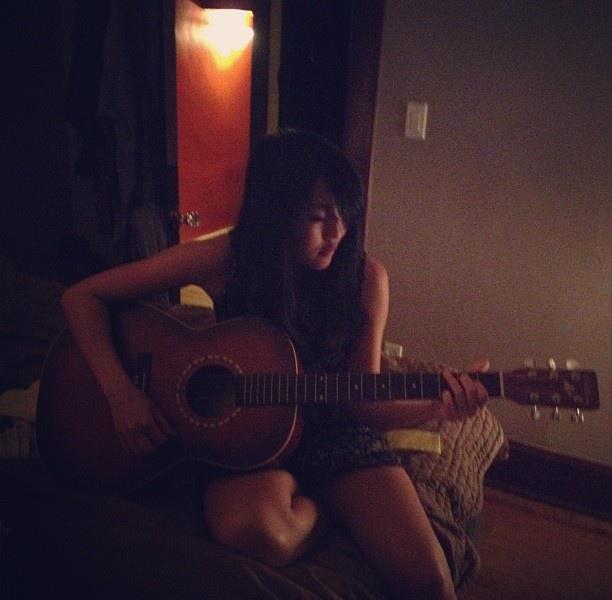
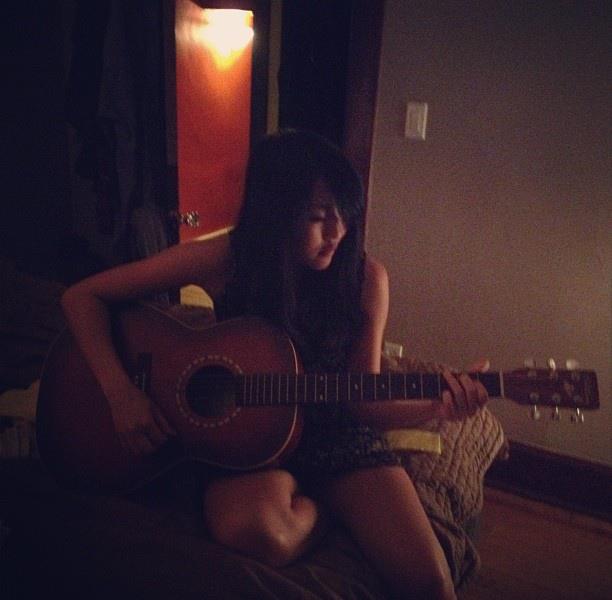
Me and my guitar, Louisa May.

Me and my guitar, Louisa May.

I also realized I was frenetic in my desire to take in as much as possible — so I wouldn’t miss anything —  but I had to learn to breathe, and whatever I needed would come to me when I needed it. Instead of holding on to the anxiety of missing out on something (if I didn’t immediately record it somehow), I learned to let in the experience as if I was slipping into a warm bath rather than being jarred by a cold shower.

I’m still learning this lesson every day.

As If, J. Allyn Rosser

How do you explain why elephants
appear to move their unwieldy hulks
with greater dignity than most humans do
in their finest moments,
as if they had evolved beyond wanting
anything but what they have?
Why does the field begin to ripple
before the wind arrives in whispers,
as if there were a communication,
as if the landscape were poorly dubbed,
and we weren’t expected to notice?
What butterfly does not dart away from us
as if it could sense our latent cruelties,
and yet return to check and double-check?
Has the night not gotten recently darker,
as if to insinuate that we have squandered
the light that was there?
Have we made too much of our own?
And did you notice afterward the dawn
opening up with a tentative eagerness
as if there were something crucial to illumine,
as if we would wake up early just to see it?
I imagine you reading this now
with an expression of quiet trouble
itself troubled by currents of hope,
as if you imagined me here with you,
as if I might be able to see your expression,
and at least answer it with mine.

Read more about this poem and poet on the Poetry Foundation website: http://bit.ly/uidQIZ.

the body shudders and clutches what it must release

So I’m turning 28 on Thursday, and it made me think of the past. Sometimes, I feel like I’m a 65-year-old woman stuck in a 20-something’s body. Maybe all this introspection makes me feel old. Oddly enough, I’ve never felt more young. Well, that’s a lie. I think I felt the youngest a few years back. I’d say from 25-26. Everything seemed possible, but in a really frightening way. Now things are still possible, but I don’t feel like hyperventilating every time I think about the future.

Sometimes I wonder if it ever ends: this uncertainty, but I guess that’s the beauty of it all. Nothing is really certain. I know I’ve learned a lot in the past three years, and I can look back with rose-coloured glasses at everything that’s happened, but sometimes I wonder if I can ever really remember those moments, really capture them. They’re so skewed now, and everything that I thought was so ugly at the time, is now so beautiful, and everything that meant so much at the time, people that meant so much to me, they barely mean anything at all.

I think we all have this desire to go back in time and tell ourselves something, anything, that would help, but that’s not the way things are. I think the real beauty of it all, is in the not knowing, not knowing what’s going to happen next, and not really understanding what has come to pass.

First Gestures, Julia Spicher Kasdorf

Among the first we learn is good-bye,
your tiny wrist between Dad’s forefinger
and thumb forced to wave bye-bye to Mom,
whose hand sails brightly behind a windshield.
Then it’s done to make us follow:
in a crowded mall, a woman waves, “Bye,
we’re leaving,” and her son stands firm
sobbing, until at last he runs after her,
among shoppers drifting like sharks
who must drag their great hulks
underwater, even in sleep, or drown.

Living, we cover vast territories;
imagine your life drawn on a map–
a scribble on the town where you grew up,
each bus trip traced between school
and home, or a clean line across the sea
to a place you flew once. Think of the time
and things we accumulate, all the while growing
more conscious of losing and leaving. Aging,
our bodies collect wrinkles and scars
for each place the world would not give
under our weight. Our thoughts get laced
with strange aches, sweet as the final chord
that hangs in a guitar’s blond torso.

Think how a particular ridge of hills
from a summer of your childhood grows
in significance, or one hour of light–
late afternoon, say, when thick sun flings
the shadow of Virginia creeper vines
across the wall of a tiny, white room
where a girl makes love for the first time.
Its leaves tremble like small hands
against the screen while she weeps
in the arms of her bewildered lover.
She’s too young to see that as we gather
losses, we may also grow in love;
as in passion, the body shudders
and clutches what it must release.

from the heart in exile

Whenever I’m about to embark upon a journey, or enter a new stage in my life, I unconsciously (or maybe consciously) seek out art that’s able to describe what I’m feeling. I remember hearing The XX two years ago (I mean, three years ago, my, how time flies), and it hooked me right from the intro. Oddly enough, Intro is my favourite out of the eleven songs from their debut album, xx.

So, I’m headed to California for a much needed vacay. It’s been a long few years. I know everyone says that, but it’s true! Haha. I’m off for a week in Cali, which will culminate at Coachella. I’ve been trying to listen to musicians that will be playing during the festival (The XX won’t be one of them, unfortunately), and I put some examples at the bottom of this post. (Although, I’ve been listening to The Black Keys and Florence + the Machine for years, M. Ward is new for me.) I’m stoked to add new music to my listening reportoire.

Tonight’s the last night for the first weekend of festivities. I bet the festival-goers don’t want to leave, which I think will be the case for me. I hope they’re having the time of their lives. I really can’t wait to be a part of this magical musical experience! And I can’t wait to see what California has in store for me.

Here I go! But first, what to pack…

The Word, Tony Hoagland

Down near the bottom
of the crossed-out list
of things you have to do today,

between “green thread”
and “broccoli” you find
that you have penciled “sunlight.”

Resting on the page, the word
is as beautiful, it touches you
as if you had a friend

and sunlight were a present
he had sent you from some place distant
as this morning — to cheer you up,

and to remind you that,
among your duties, pleasure
is a thing,

that also needs accomplishing
Do you remember?
that time and light are kinds

of love, and love
is no less practical
than a coffee grinder

or a safe spare tire?
Tomorrow you may be utterly
without a clue

but today you get a telegram,
from the heart in exile
proclaiming that the kingdom

still exists,
the king and queen alive,
still speaking to their children,

— to anyone among them
who can find the time,
to sit out in the sun and listen.

(poem from The Wondering Minstrel‘s blog)

in that place i bled, was tortured

Motivation is a tricky thing. At times, I can trick myself into thinking that I’m not writing this epic novel, that this monumental task is not a big deal; I can do this in my sleep… This is something I tell myself to keep going, to keep writing, even without any external reward. The very act of writing must be enough to sustain me, but I also find that surrounding myself with hardworking people who are brimming with passion is key. I also try to make time for the quiet moments, and I’m slowly learning the gift of gratitude.

My Message, Cecil Rajendra

And now you ask
what is my message
i say with Nabokov
i am a poet
not a postman
i have no message.

but i want the cadences
of my verse to crack
the carapace of indifference
prise open torpid eyelids
thick-coated with silver.

i want syllables
that will dance, pirouette
in the fantasies of nymphets
i want vowels that float
into the dreams of old men.

i want my consonants
to project kaleidoscopic visions
on the screens of the blind
& on the eardrums of the deaf
i want pentameters that sing
like ten thousand mandolins.

i want such rhythms
as will shake pine
angsana, oak & meranti
out of their pacific
slumber, uproot them-
selves, hurdle over
buzz-saw & bull-dozer
and rush to crush
with long heavy toes
merchants of defoliants.

i want stanzas
that will put a sten-gun
in the paw of polar-bear & tiger
a harpoon under the fin
of every seal, whale & dolphin
arm them to stem
the massacre of their number.

i want every punctuation—
full-stop, comma & semi-colon
to turn into a grain of barley
millet, maize, wheat or rice
in the mouths of our hungry;
i want each & every metaphor
to metamorphose into a rooftop
over the heads of our homeless.

i want the assonances
of my songs to put smiles
on the faces of the sick
the destitute & the lonely
pump adrenaline into the veins
of every farmer & worker
the battle-scarred & the weary.

and yes, yes, i want my poems
to leap out from the page
rip off the covers of my books
and march forthrightly to
that sea of somnolent humanity
lay bare the verbs, vowels
syllables, consonants… & say
“these are my sores, my wounds:
this is my distended belly:
here i went ragged and hungry:
in that place i bled, was tortured;
and on this electric cross i died.
Brothers, sisters, HERE I AM.”

Rajendra, Cecil. “My Message.” The Poetry of Our World: An International Anthology of Contemporary Poetry. Ed. Jeffrey Paine et al. New York: HarperCollins, 2000.

There shall be eternal summer in the grateful heart.
– Celia Thaxter

the color of its countries

In honour of Valentine’s Day, slash, commercialized love day, I’d like to share my favourite love poem. Well, it’s actually my favourite poem, which just happens to be a love poem–quelle surprise! (I’m trying to relearn French and display how well-versed I am in other languages… I took French in university (twice), but only because I had to. I’m also trying to relearn Lao and Thai. What am I talking about? Right.) So… my favourite poem is a love poem by ee cummings.

I have not come across another poem that is able to describe the maddening and soothing nature of love so eloquently. Although, I have a handful of love poems that are very dear to me, this one would have to be at the top. I hope to one day write a poem that is even a shade as beautiful as the following, even though Rainer Maria Rilke warns young poets against this endeavour: “Do not write love-poems; avoid at first those forms that are too facile and commonplace: they are the most difficult, for it takes a great, fully matured power to give something of your own where good and even excellent traditions come to mind in quantity” (16).

So until then, I’ll try my hand at some contrived and overwrought love poems. But here’s a love poem that brings insight and beauty to the highest level.

somewhere i have never travelled,gladly beyond by ee cummings

somewhere i have never travelled,gladly beyond
any experience,your eyes have their silence:
in your most frail gesture are things which enclose me,
or which i cannot touch because they are too near

your slightest look easily will unclose me
though i have closed myself as fingers,
you open always petal by petal myself as Spring opens
(touching skilfully,mysteriously)her first rose

or if your wish be to close me, i and
my life will shut very beautifully ,suddenly,
as when the heart of this flower imagines
the snow carefully everywhere descending;

nothing which we are to perceive in this world equals
the power of your intense fragility:whose texture
compels me with the color of its countries,
rendering death and forever with each breathing

(i do not know what it is about you that closes
and opens;only something in me understands
the voice of your eyes is deeper than all roses)
nobody,not even the rain,has such small hands

Rilke, Rainer Maria. Letters to a Young Poet. Trans. M. D. Herter Norton. New York: W. W. Norton & Co, 1954.

it is fitting and delicious to lose everything

I have this thing where I love to drive. It doesn’t matter where. Sometimes I’ll drive for the sake of driving, so I’ll feel like I’m heading somewhere, going some place. This is especially true in the summer. I just drive and imagine that I’m headed somewhere great. I remember in the summer, I would drive down country roads, trying to find my friend’s house among the vast expanse of fields and dirt roads, and I would listen to Colin Hay’s Waiting for My Real Life to Begin, knowing that my life was happening, right then, right at that moment. It was both a great and painful experience. I never wanted to stop driving and listening to the music, but eventually, I would make it to my friend’s house (after being lost for sometime—I blame the outdated GPS), turn off the music, turn off the engine, and step out from the car.

Affirmation, Donald Hall

To grow old is to lose everything.
Aging, everybody knows it.
Even when we are young,
we glimpse it sometimes, and nod our heads
when a grandfather dies.
Then we row for years on the midsummer
pond, ignorant and content. But a marriage,
that began without harm, scatters
into debris on the shore,
and a friend from school drops
cold on a rocky strand.
If a new love carries us
past middle age, our wife will die
at her strongest and most beautiful.
New women come and go. All go.
The pretty lover who announces
that she is temporary
is temporary. The bold woman,
middle-aged against our old age,
sinks under an anxiety she cannot withstand.
Another friend of decades estranges himself
in words that pollute thirty years.
Let us stifle under mud at the pond’s edge
and affirm that it is fitting
and delicious to lose everything.

Most people don’t grow up. Most people age. They find parking spaces, honor their credit cards, get married, have children, and call that maturity. What that is, is aging.
— Maya Angelou

things I didn’t know I loved

trees

Things I Didn’t Know I Loved, Nâzım Hikmet

it’s 1962 March 28th
I’m sitting by the window on the Prague-Berlin train
night is falling
I never knew I liked
night descending like a tired bird on a smoky wet plain
I don’t like
comparing nightfall to a tired bird

I didn’t know I loved the earth
can someone who hasn’t worked the earth love it
I’ve never worked the earth
it must be my only Platonic love

and here I’ve loved rivers all this time
whether motionless like this they curl skirting the hills
European hills crowned with chateaus
or whether stretched out flat as far as the eye can see
I know you can’t wash in the same river even once
I know the river will bring new lights you’ll never see
I know we live slightly longer than a horse but not nearly as long
as a crow
I know this has troubled people before
and will trouble those after me
I know all this has been said a thousand times before
and will be said after me

I didn’t know I loved the sky
cloudy or clear
the blue vault Andrei studied on his back at Borodino
in prison I translated both volumes of War and Peace into Turkish
I hear voices
not from the blue vault but from the yard
the guards are beating someone again

I didn’t know I loved trees
bare beeches near Moscow in Peredelkino
they come upon me in winter noble and modest
beeches are Russian the way poplars are Turkish
“the poplars of Izmir
losing their leaves…
they call me The Knife…
lover like a young tree…
I blow stately mansion sky-high”
in the Ilgaz woods in 1920 I tied an embroidered linen handkerchief
to a pine bough for luck

I never knew I loved roads
even the asphalt kind
Vera’s behind the wheel we’re driving from Moscow to the Crimea
Koktebele
formerly “Goktepé ili” in Turkish
the two of us inside a closed box
the world flows past on both sides distant and mute
I was never so close to anyone in my life
bandits stopped me on the red road between Bolu and Geredé
when I was eighteen
apart from my life I didn’t have anything in the wagon they could take
and at eighteen our lives are what we value least
I’ve written this somewhere before
wading through a dark muddy street I’m going to the shadow play
Ramazan night
a paper lantern leading the way
maybe nothing like this ever happened
maybe I read it somewhere an eight-year-old boy
going to the shadow play
Ramazan night in Istanbul holding his grandfather’s hand
his grandfather has on a fez and is wearing the fur coat
with a sable collar over his robe
and there’s a lantern in the servant’s hand
and I can’t contain myself for joy

flowers come to mind for some reason
poppies cactuses jonquils
in the jonquil garden in Kadikoy Istanbul I kissed Marika
fresh almonds on her breath
I was seventeen
my heart on a swing touched the sky
I didn’t know I loved flowers
friends sent me three red carnations in prison

I just remembered the stars
I love them too
whether I’m floored watching them from below
or whether I’m living at their side

I have some questions for the cosmonauts
were the stars much bigger
did they look like huge jewels on black velvet
or apricots on orange
did you feel proud to get closer to the stars
I saw color photos of the cosmos in Ogonek magazine now don’t
be upset comrades but nonfigurative shall we say or abstract
well some of them looked just like such paintings which is to
say they were terribly figurative and concrete
my heart was in my mind looking at them
they are our endless desire to grasp things
seeing them I could even think of death and not feel at all sad
I never knew I loved the cosmos

snow flashes in front of my eyes
both heavy wet steady snow and the dry whirling kind
I didn’t know I liked snow

I never knew I loved the sun
even when setting cherry-red as now
in Istanbul too it sometimes sets in postcard colors
but you aren’t about to paint it that way
I didn’t know I loved the sea
except the Sea of Azov
or how much

I didn’t know I loved clouds
whether I’m under or up above them
whether they look like giants or shaggy white beasts

moonlight the falsest the most languid the most petit-bourgeois
strikes me
I like it

I didn’t know I liked rain
whether it falls like a fine net or splatters against the glass my
heart leaves me tangled up in a net or trapped inside a drop
and takes off for unchartered countries I didn’t know I loved
rain but why did I suddenly discover all these passions sitting
by the window on the Prague-Berlin train
is it because I lit my sixth cigarette
one alone could kill me
is it because I’m half dead from thinking about someone back in
Moscow
her hair straw-blond eyelashes blue

the train plunges on through the pitch-black night
I never knew I liked the night pitch-black
sparks fly from the engine
I didn’t know I loved sparks
I didn’t know I loved so many things and I had to wait until sixty
to find it out sitting by the window on the Prague-Berlin train
watching the world disappear as if on a journey of no return

(translated from the Turkish by Randy Blasing and Mutlu Konuk)

(Note: For the correct line spacing please refer to the book below.)

Hikmet, Nâzım. “Things I Didn’t Know I Loved.” The Vintage Book of Contemporary World Poetry. Ed. J. D. McClatchy. New York: Random House, 1996. 240-243.

It was as if to be broken was love

I know what it’s like to love someone who hurts you. “The Far Field” is able to capture this inner conflict with excruciating tenderness.

The Far Field, Patrick Lane

We drove for more than an hour, my father’s hands
on the truck’s wheel, taking us farther and farther
into the hills, both of us watching
the sagebrush and spare pines drift
past, both of us silent. He did not know
what to do with me. I think he thought of
my death, as a man will whose son has chosen
to destroy. I think that’s why he drove
so long, afraid to stop for fear
of what he’d do. My mother had cried
when we left, her hands over her mouth,
saying through her splayed fingers
my father’s name, speaking
that word as if it were a question. I
sat there peaceful with him,
knowing for these hours he was wholly mine.

He stripped me naked in the last hour of day
and made me stand with my back to him, my bare
feet in dust, my back and buttocks to him,
a naked body, hands braced upon the hood,
staring across the metal at the hills.

I remember the limb of the tree falling
upon me, the sound of the white wood crying
as it hurt the air, and the flesh of my body
rising to him as I fell to the ground and rose
only to fall again. I don’t remember pain,
remember only what a body feels
when it is beaten, the way it resists
and fails, and the sound of my flesh.

I rose a last time, my father dropping
the last limb of the tree beside me.
I stood there in my bones wanting it not to be
over, wanting what had happened to continue, to go
on and on forever, my father’s hands on me.

It was as if to be broken was love, as if
the beating was a kind of holding, a man
lifting a child in his huge hands and throwing him
high in the air, the child’s wild laughter
as he fell a question spoken into both their lives,
the blood they shared pounding in their chests.

It does get better. Tell someone you trust.

Yes, all of this is sorrow. But leave
a little love burning always
like the small bulb in the room of a sleeping baby
that gives him a bit of security and quiet love
though he doesn’t know what the light is
or where it comes from
– Yehuda Amichai

will hear all I say and cannot say

Invariably, life presents us with many choices: who we want to become, who we want to be with, what we want to do with our lives. At first glance, these decisions seem monumental, but eventually we come to make key choices that shape our lives.

I’ve been very fortunate to come upon friends who have been able to help and encourage me. They are varied, flawed, but beautiful people. Some strengthen, some challenge, some provoke, some comfort, but all are necessary.

I’m grateful for these friendships, and I’m not sure what led me to them, or what led them to me, but I’m happy to have these people in my life. They make me feel less alone, and even if I can’t always be with them, I know they’re thinking about me, as I’m thinking about them.

Paula Becker To Clara Westhoff, Adrienne Rich

The autumn feels slowed down,
summer still holds on here, even the light
seems to last longer than it should
or maybe I’m using it to the thin edge.
The moon rolls in the air. I didn’t want this child.
You’re the only one I’ve told.
I want a child maybe, someday, but not now.
Otto has a calm, complacent way
of following me with his eyes, as if to say
Soon you’ll have your hands full!
And yes, I will; this child will be mine
not his, the failures, if I fail
will all be mine. We’re not good, Clara,
at learning to prevent these things,
and once we have a child it is ours.
But lately I feel beyond Otto or anyone.
I know now the kind of work I have to do.
It takes such energy! I have the feeling I’m
moving somewhere, patiently, impatiently,
in my loneliness. I’m looking everywhere in nature
for new forms, old forms in new places,
the planes of an antique mouth, let’s say, among the leaves.
I know and do not know
what I am searching for.
Remember those months in the studio together,
you up to your strong forearms in wet clay,
I trying to make something of the strange impressions
assailing me–the Japanese
flowers and birds on silk, the drunks
sheltering in the Louvre, that river-light,
those faces… Did we know exactly
why we were there? Paris unnerved you,
you found it too much, yet you went on
with your work… and later we met there again,
both married then, and I thought you and Rilke
both seemed unnerved. I felt a kind of joylessness
between you. Of course he and I
have had our difficulties. Maybe I was jealous
of him, to begin with, taking you from me,
maybe I married Otto to fill up
my loneliness for you.
Rainer, of course, knows more than Otto knows,
he believes in women. But he feeds on us,
like all of them. His whole life, his art
is protected by women. Which of us could say that?
Which of us, Clara, hasn’t had to take that leap
out beyond our being women
to save our work? or is it to save ourselves?
Marriage is lonelier than solitude.
Do you know: I was dreaming I had died
giving birth to the child.
I couldn’t paint or speak or even move.
My child–I think–survived me. But what was funny
in the dream was, Rainer had written my requiem–
a long, beautiful poem, and calling me his friend.
I was your friend
but in the dream you didn’t say a word.
In the dream his poem was like a letter
to someone who has no right
to be there but must be treated gently, like a guest
who comes on the wrong day. Clara, why don’t I dream of you?
That photo of the two of us–I have it still,
you and I looking hard into each other
and my painting behind us. How we used to work
side by side! And how I’ve worked since then
trying to create according to our plan
that we’d bring, against all odds, our full power
to every subject. Hold back nothing
because we were women. Clara, our strength still lies
in the things we used to talk about:
how life and death take one another’s hands,
the struggle for truth, our old pledge against guilt.
And now I feel dawn and the coming day.
I love waking in my studio, seeing my pictures
come alive in the light. Sometimes I feel
it is myself that kicks inside me,
myself I must give suck to, love…
I wish we could have done this for each other
all our lives, but we can’t…
They say a pregnant woman
dreams her own death. But life and death
take one another’s hands. Clara, I feel so full
of work, the life I see ahead, and love
for you, who of all people
however badly I say this
will hear all I say and cannot say.

Oh, the comfort–the inexpressible comfort of feeling safe with a person, having neither to weigh thoughts, nor measure words, but pouring them out, just as they are, chaff and grain together; knowing that a faithful hand will take and sift them–keep what is worth keeping–and with the breath of kindness blow the rest away.
– Anonymous (often attributed to George Eliot or Dinah Mulock Craik)