letter to a lost friend

Letter to a Lost Friend, Barbara Hamby

There must be a Russian word to describe what has happened
              between us, like ostyt, which can be used
for a cup of  tea that is too hot, but after you walk to the next room,
              and return, it is too cool; or perekhotet,
which is to want something so much over months
              and even years that when you get it, you have lost
the desire. Pushkin said, when he saw his portrait by Kiprensky,
              “It is like looking into a mirror, but one that flatters me.”
What is the word for someone who looks into her friend’s face
              and sees once smooth skin gone like a train that has left
the station in Petersburg with its wide avenues and nights
              at the Stray Dog Cafe, sex with the wrong men,
who looked so right by candlelight, when everyone was young
              and smoked hand-rolled cigarettes, painted or wrote
all night but nothing good, drank too much vodka, and woke
              in the painful daylight with skin like fresh cream, books
everywhere, Lorca on Gogol, Tolstoy under Madame de Sévigné,
              so that now, on a train in the taiga of  Siberia,
I see what she sees — all my books alphabetized and on shelves,
              feet misshapen, hands ribbed with raised veins,
neck crumpled like last week’s newspaper, while her friends
              are young, their skin pimply and eyes bright as puppies’,
and who can blame her, for how lucky we are to be loved
              for even a moment, though I can’t help but feel like Pushkin,
a rough ball of  lead lodged in his gut, looking at his books
              and saying, “Goodbye, my dear friends,” as those volumes
close and turn back into oblong blocks, dust clouding
              the gold leaf that once shimmered on their spines.


Read more about this poem and poet on the Poetry Foundation website: http://bit.ly/149Pv0R.

it is fitting and delicious to lose everything
– Donald Hall

with those we can no longer love

Falling by Nokyoung Xayasane

The golden leaves fell softly, gently oscillating in their descent. She sat there silently, looking out into the field from the tiny chapel window. Her breath quickened, and she wished that for one split second — everything would just stop. If only the present time could be hushed and imbued with reassuring stillness, but life wasn’t like that; it moves as if propelled towards something greater.

Sophia sat immobile. Her long white wedding dress enveloped her slight frame as she watched the leaves falling slowly to the ground; their golden descent matching her tears. Her arm moved upwards, struggling out of a dense mud, caked with lethargy. She wiped her tears away.

And then it happened — as it always did: She saw him, youthful and optimistic, under that tree, smiling at her quizzically, and she could almost touch him, as one who is able to touch the past. But he wasn’t there. He was somewhere that she could never reach. Even years later when she saw him at the theatre, he remained someone untouchable, unalterable. His hair had become sparser at the sides, but she could have recognized that energy anywhere; it calmed her and energized her simultaneously.

“Sophia, my God, it’s been so long. How are you?” He had asked her that numerous times in the past and it had always thrown her off guard, as if she were realizing for the first time that she existed and felt things as person.

“I’m well. How have you been, Owen?” The distance between them minimized. They stood there alone, except for the flakes that began to descend. Their intimacy — short in distance, but heavy with things left unsaid. She smiled; the light never reaching her eyes. He smiled back at her genuinely, but always curiously. In that one shared look she felt the impossibility of them sharing any space together for more than a few minutes, and the conversation meandered, never settling in one place, never standing still, and eventually they moved away from each other as their words lost any semblance of meaning. The distance between them expanded, and the crowd of people materialized around them.

“Well, it was nice to see you again.” As he said this he moved his hand to touch her shoulder, reminding her of the ever-present awkwardness between them. Two people who were too joined in mental space to exist properly in physical space.

“Yes, it was nice. I hope you continue… to be well.”

“You too.”

“Well, see you when I see you.”

“Who knows, maybe it’ll be less than five years before we run into each other again,” he joked, his eyes smiling.

“Yeah,” Sophia laughed softly. She wanted to reach out and touch him gently. She wanted to strangle him.

“Well, only time will tell,” he trailed off, lost somewhere. “Okay, bye then,” abruptly spoken.

“Bye.”

They moved away from each other into their own realities, but those moments stood still for her. She looked at herself in the mirror. Her face flushed, pulsating. She stood up and the train of white material rustled after her. The cool flow of air entered the room as she quickly opened the chapel window. Autumn air rushed in and the sound of the leaves rustled in tune with her dress as she fanned herself with her now feverish hands.

“This is not how I imagined it would happen.” Her youthful voice came to her from somewhere far off.

“What did you think was going to happen?” They were at the tree again. A light mist of rain fell, barely perceptible under the canopy. Sophia sat next to him with her legs folded into her body; her arms encircling herself, clutching at an unattainable comfort. He stretched his legs outward, looking at her with unbearable rationality. “That we could just get up and go?”

“If you asked me to go, I’d go.” Her intensity surprised even herself. She didn’t really want to go anywhere with him; she just wanted to sit still with him, to be with him, but this plan made things seem less real: running away together to somewhere far off instead of being here, in this space.

“Sophia, you’d hate me. The farther I took you away from Jacob, from your family, the more you’d regret it. By the time we reached the 401 you’d wished you had never decided to go.” Owen looked at her and she felt as if she were falling from a precipice, from somewhere she had been standing without realizing it. “You don’t even know me. We don’t even know each other,” he reasoned.

“But I want to know you.” Her naivety rang sharply in her ears. If only he would see it her way. If only he could.

“I’m someone that you’ve created in your mind. I’m not this person that you think I am,” he countered.

A deep sigh escaped from her lips. “I wish you existed.”

“I wish you existed.”

“Who?” asked her mother.

“Mom, what are you doing in here?”

“Well, honey, we’re waiting for you. Everyone’s waiting for you. Jacob’s waiting for you.”

“Okay Mom, I just need one more minute.”

“Is everything okay, Sophia?”

“Yeah, of course. I just need more time.” Only time will tell, Owen had said.

“Okay, sweetheart. I’ll be waiting for you outside.” Her mother softly closed the door behind her and Sophia was back at the tree.

“What if we came back to this spot in five years?” She looked at Owen helplessly.

“No, Sophia, I can’t do that. I won’t do that. If you leave Jacob it has to be because of what he’s done or what he isn’t. It can’t be for me. It has to be for you.”

“Sophia, it’s all been for you,” argued Jacob as they faced each other in the kitchen, a year before their wedding day.

“What has?”

“What do you mean? Everything has been for you: the ring, the house, everything!”

She wished she could feel something more. A part of her yearned to stay with him, but she was already gone. Her mind wandered past sandy terrains, past the cloak that had shielded her for all these years. I know you want to keep me here, but I cannot stay.

“Why do you want to be with me?”

“Because I’m only happy when you’re around. I need you.”

She could feel the cloak begin to tighten. A warm pain festered within her chest and she struggled to breathe. He held her then and the pain subsided, placated by his touch. His mouth moved above her, inside her, around her, and she fell into him. The ceramic tiles were cold against her back. He moved above her, looking down at her. He loves me, she thought, and her tears fell.

The autumn wind blew in through the chapel window. The leaves called out to her, called out for her to run. She clamoured up the windowsill and fell the short distance to the ground. The leaves crunched beneath her feet. Her heels pounded against the grass. More leaves fell around her — falling past her.  She ran, ran, ran. Never stopping.

A soft knock sounded at the door. “Are you ready? The music is about to start.” Sophia looked away from the window.

“Yes Mom, I’m coming.” For one moment, she stood still. She could feel the hard jut of the baseboard, the stickiness of skin on tile, the gasping breaths between two warm bodies.

She could feel the snow falling, melting on her face, the way snow surprises you with its first touch. And the rain. The drops of rain that made their way through the overhanging canopy; the drops that had fallen lightly between two youthful figures.

I wish you existed. Words reverberating from a past that moved forward without heed. I wish you didn’t need me so much.

Once the leaves outside were green, but they had changed to a golden hue, something altogether different, she thought. They perched on the tips of branches but eventually they must fall, softly floating down in their fragility to meet with the hard ground. She moved away from the window and the falling leaves.

The door opened and artificial light entered the room. She turned to face the light. Her mother’s face fell.

you call out to me from your hiding place

Lao New Year, the water ceremony

Lao New Year, the water ceremony

So Father’s Day is tomorrow. It made me think of a poem I wrote for my dad when I was 22 years old.

Seven years ago!* Crazy.

Last weekend, I celebrated my 29th birthday. Birthdays make me feel pretty nostalgic. Well, if I’m being truthful, anything makes me nostalgic: the melody of a song, the way the air smells after the rain, or any number of overwrought poetic imagery that I won’t bore you with, but birthdays really do it for me. It’s a time to reflect and look back on what’s happened and to try to move on.

Now that I’m a year older and with Father’s Day around the corner, it made me think about my dad. My dad and I have had a perplexing relationship. I remember a time when I thought he knew everything. I remember feeling like he was my protector. I remember feeling safe with him.

But then things changed.

Our relationship began to unravel after me, my mom, and dad immigrated to Canada. It’s only in looking back that I realize the turmoil he was going through. He was a highly educated young man from Laos, but in Canada he was no one. He couldn’t speak the language. He felt like an outsider. He felt like less than a person.

Sadly, he took his frustrations out on the ones he loved: my mom and me. Although I don’t condone what happened between me and him and my mom, I’ve tried over the years to understand why our family life was filled with verbal and physical abuse.

I know my dad has made great strides to change himself. He’s now a pastor at the church I grew up in when we arrived in Canada. I’m really proud of him and every time he stands at the podium to speak, I can’t help but remember the man who had once been my protector and who had made me feel safe all those years ago.

Heal, Nokyoung Xayasane

when I was younger I clung to you
the roots of a tree gripping the riverbank
shifting waters could not move us
enveloped by mosquito netting and protected
while balmy breezes blew within a decrepit shanty
the cracks would not let in the pain

shards of light reflecting mirror side up
bruised forearm, broken finger
I cannot find you in your dark
hidden by your rage, I search for you

the splashing, laughing pool
flipping through the pages of a torn photo album
you call out to me from your hiding place
a quiet voice beneath the fists
loving pain, gentle brutality
comforting violence

sometimes, glimpses of you emerge
falling rain, glimmering laughter
and I hope for your light

my image in your eyes
my movements in your stance
quiet rage
shifting below
whispering madness seeps into light
mosquito netting, broken finger
morning grass, afternoon tag
and I remember you
as you were, as you are now

soft folds of a blanket
and the radio hums within the hut
hammock swaying
cradled in the softness, protected in the netting

soothing cooling
ointment glides on the burn
healing tissue replacing cut
a soft scar in the shadow of forgiveness
and I can see your light

(2009)

*Update: I just realized I wrote this poem when I was 25 years old and not 22 years old. I wrote a similar poem about my dad at 22, which had a less hopeful tone to it. The one above was written during a Creative Writing course while I was in University.

I glimpse through bewildered eyes

My mom’s birthday was two days ago. We went out for her birthday lunch on Saturday and my sister mentioned she had found my old autobiography that I had written in grade 7, I think.

She told me there were two sections that caught her eye. One section was about my ideal sister and one was about my ideal mother.

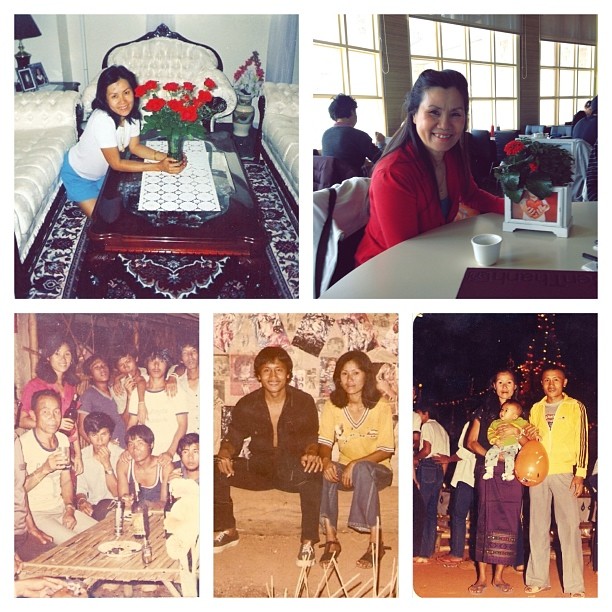
mom_birthday_collage

Homage to my hero (Photo credit: nokxayasane/Instagram)

I don’t remember much about what I wrote, but I do remember writing that my mom is my real-life hero. It always puzzled me when kids would say their heroes were movie stars or athletes. How do you know if they’re even good people, I had thought.

When I came across Jeannette Armstrong’s “Threads of Old Memory,” I couldn’t help but think about my mom and my family. It reminded me of the battles we had with each other, the struggles we all faced in coping with a new country, and the aftermath of my family’s arrival in Canada.

My father, my mother, and I had arrived in Cambridge, Ontario, from a refugee camp in Nakhon Phanom, Thailand, (where I was born). This was our chance at a better life, but it was a rocky road, to say the least.

We faced many hardships, but in the end, I knew my parents loved me. Their love and sacrifice is something I will always cherish.

Threads of Old Memory, Jeannette Armstrong

Speaking to newcomers in their language is dangerous
for when I speak
history is a dreamer
empowering thought
from which I awaken the imaginings of the past
bringing the sweep and surge of meaning
coming from a place
rooted in the memory of loss
experienced in ceremonies
wrenched from the minds of a people
whose language spoke only harmony
through a language
meant to overpower
to overtake
in skillfully crafted words
moving towards surrender
leaving in its swirling wake
only those songs
hidden
cherished
protected
the secret singing of which
I glimpse through bewildered eyes
an old lost world
of astounding beauty

When I speak
I attempt to bring together
with my hands
gossamer thin threads of memory
thoughts from the underpinnings of understanding
words seeped in age
slim
barely visible strands of harmony
stretching across the chaos brought into the world
through words
shaped as sounds in air
meaning made physical
changers of the world
carriers into the place of things
from a place of magic
the underside of knowing
the origination place
a pure place
silent
wordless
from where thoughts I choose
silently transform into words
I speak and
powerfully become actions
becomes memory in someone
I become different memories to different people
different stories in the retelling of my place
I am the dreamer
the choice maker
the word speaker
I speak in a language of words
formed of the actions of the past
words that become the sharing
the collective knowing
the links that become a people
the dreaming that becomes a history
the calling forth of memory
I am the weaver of memory thread
twining past to future
I am the artist
the storyteller
the singer
from the known and familiar
pushing out into darkness
dreaming splinters together
the coming to knowing

When I speak
I sing a song called up through ages
of carefully crafted rhythm
of a purpose close to the wordless
in a coming to this world
from the cold and hunger spaces in the heart
through the desolate and lost places of the mind
to this stark and windswept mountain top
I search for the sacred words
spoken serenely in the gaps between memory
the lost places of history
pieces mislaid
forgotten or stolen
muffled by violence
splintered by evil
when languages collide in mid air
when past and present explode in chaos
and the imaginings of the past
rip into the dreams of the future

When I speak
I choose the words gently
asking the whys
dangerous words
in the language of the newcomers
words releasing unspeakable grief
for all that is lost
dispelling lies in the retelling
I choose threads of truth
that in its telling cannot be hidden
and brings forward
old words that heal
moving to a place
where a new song begins
a new ceremony
through medicine eyes I glimpse a world
that cannot be stolen or lost
only shared
shaped by new words
joining precisely to form old patterns
a song of stars
glittering against an endless silence

we belong somewhere

If you had asked me where I wanted to be when I was in my mid-twenties, my answer would’ve been, “Anywhere but here.” It didn’t matter where as long as I was far away from everything I had ever known and anyone whom I had ever loved and still loved.

venice-beach

Venice Beach, Los Angeles (Photo credit: nokxayasane/Instagram)

I wanted to be totally lost and plunged into a different life: A life where I never had to see the people who hurt me, who loved me, who missed me, who disappointed me.

It seemed like the only way to be happy. But then I learned that I needed people just as much as they needed me. I learned that no matter where I went, I couldn’t run from myself nor from my people in my life. I learned eventually that I do belong somewhere, and I didn’t have to search very far to find that place.

Lonely for the Country, Bronwen Wallace

Sometimes these days
you think you are ready
to settle down.

This might be the season for it,
this summer of purple sunsets
when you stand in the streets
watching the sky, until its colour
is a bruised place
inside your chest.

When you think of settling down
you imagine yourself growing comfortable
with the land and remember the sustained faces
of men like your grandfather, the ridges of black veins
that furrowed the backs of their hands as they squared
a country boundary for you, or built once more
old Stu McKenzie’s barn exactly as they’d raised it
60 years ago.
You watch the hands of the women
on market days, piling onions, filling buckets
with tomatoes, their thick, workaday gestures
disclosing at times
what you think you recognize as caring,
even love.

At least that’s how it looks
from the outside and when you think
of settling down, you always think of it
as a place.

It makes the city seem imaginary, somehow.
As you drive through the streets,
you begin to see how the lives there look
as if they had been cut from magazines:
a blond couple carrying a wicker picnic-basket
through the park, a man in faded brown shorts
squatting on his front lawn
fixing a child’s red bike.

You wish you could tell yourself
that this is all too sentimental.
You want to agree with the person
who said, “There’s no salvation
in geography.”

But you can’t
and you’re beginning to suspect
that deep within you,
like a latent gene, is this belief
that we belong somewhere.

What you know
is that once you admit that
it opens in you
a deeper need.
A need like that loneliness
which makes us return again and again
to the places we shared
with those we can no longer love,
empty-hearted, yet expectant,
searching for revelations
in the blank faces of remembered houses.

As wide as bereavement
and dangerous,
it renders us innocent
as mourners at a graveside
who want to believe their loss
has made this holy ground
and wait
for the earth beneath their feet
to console them.

Wallace, Bronwen. “Lonely for the Country.” Common Magic. Canada: Oberon Press, 1985.

as if you imagined me here with you

I think we all have images of how our lives will turn out. Usually, reality and fantasy are two disparate images. I didn’t find this out until much later, but it’s difficult to know what you think you want, what you actually want, and what’s really good for you. I find it’s all about timing. Who I am and what I want changes with the experiences I’ve taken in. This sounds like common sense. But it’s not until you look back on the events that have transpired and the people you once knew, do you see them for what and who they really are.

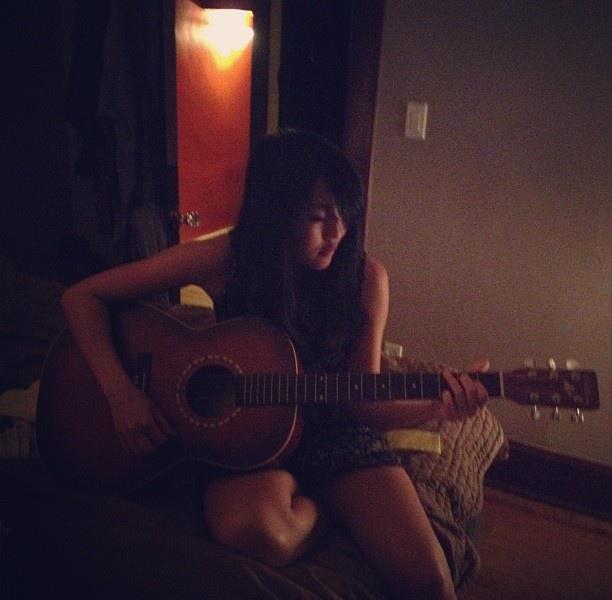
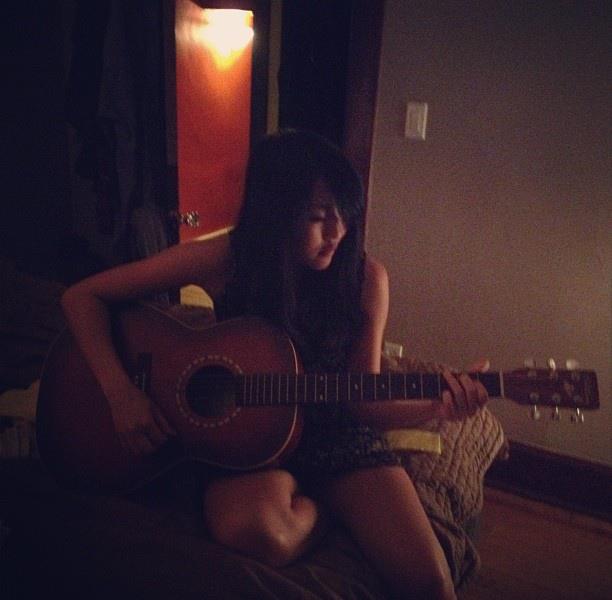
Me and my guitar, Louisa May.

Me and my guitar, Louisa May.

I also realized I was frenetic in my desire to take in as much as possible — so I wouldn’t miss anything —  but I had to learn to breathe, and whatever I needed would come to me when I needed it. Instead of holding on to the anxiety of missing out on something (if I didn’t immediately record it somehow), I learned to let in the experience as if I was slipping into a warm bath rather than being jarred by a cold shower.

I’m still learning this lesson every day.

As If, J. Allyn Rosser

How do you explain why elephants
appear to move their unwieldy hulks
with greater dignity than most humans do
in their finest moments,
as if they had evolved beyond wanting
anything but what they have?
Why does the field begin to ripple
before the wind arrives in whispers,
as if there were a communication,
as if the landscape were poorly dubbed,
and we weren’t expected to notice?
What butterfly does not dart away from us
as if it could sense our latent cruelties,
and yet return to check and double-check?
Has the night not gotten recently darker,
as if to insinuate that we have squandered
the light that was there?
Have we made too much of our own?
And did you notice afterward the dawn
opening up with a tentative eagerness
as if there were something crucial to illumine,
as if we would wake up early just to see it?
I imagine you reading this now
with an expression of quiet trouble
itself troubled by currents of hope,
as if you imagined me here with you,
as if I might be able to see your expression,
and at least answer it with mine.

Read more about this poem and poet on the Poetry Foundation website: http://bit.ly/uidQIZ.

what we all long for

It’s been six months since I’ve updated my blog. I think I had to deal with my big revelation (from my last post) with a little bit of silence. I find that once you’ve said something big, it’s best to stay quiet for a little while after, to keep things in balance, and to get your grounding back.

Right now, I’m reading a book by Dionne Brand called What We All Long For. I adore this woman’s work. In my last year at university, I wrote an essay about her book of poetry Thirsty, which is a moving and rich work. Now I’ve moved on to her novels. What We All Long For really resonates with me. I’ve only read the first few chapters, but I can empathize with the main character perfectly: Tuyen is an *immigrant from Vietnam who produces avant-garde installations. The story hinges on her family’s struggle to find her missing brother, who was lost when the family fled from Vietnam to Thailand.

I understand her struggle. Although, I don’t remember much about the **Thai refugee camp that my family stayed in, I do remember mosquito netting, for some strange reason. I was born in that camp as a displaced person. It’s been 23 years since those first five years living in the camp. My mom has a lot of quirky stories from that time, but there are many stories that I sometimes wish I didn’t know. She told me some things about her life before meeting my dad, and what she told me inspired me to write this short story. I wrote it in my university creative writing class in 2010 (I think), and I haven’t revised it since. I wrote it to try to understand what she had gone through. I hope you enjoy it.

* Update (01/28/2013): Upon further reading, I discovered that Tuyen isn’t an immigrant. She was born in Toronto. Her parents and her two older sisters are immigrants from Vietnam (along with her lost brother). She’s the youngest of five siblings with another older brother who was also born in Toronto.

** Note (01/28/2013): My background is Lao.

Cut

Alice felt an overwhelming desire to reach over to her mother, grab her by the roots of her hair, fist the black locks at the base of her skull, and repeatedly slam her face into the dashboard. Her fingers itched as she rubbed them against her jeans. She moved the car out of the driveway and turned onto the deserted road. They sat together as the heat radiated and circulated within the confines of the car. The sun had not yet risen, and the darkness moved fluidly in front of the headlights.

She wondered how her mother felt: waking up in total darkness, trudging to her minimum wage job, exerting herself in repetitive, graceless tasks, and returning in that same darkness to their dilapidated house. Sure, she had a short lunch break between her endless hours of sewing, but how did it feel to move in perpetual darkness?

“All I’m saying is that you shouldn’t cut your hair,” her mother retorted, rummaging through her oversized purse. She removed a tube of lip-gloss from her scattered things and serenely applied it—her eyes intent on the mirror. “Why do you need to cut it? It’s beautiful just the way it is.” She rubbed the gloss onto her thinning lips as she spoke.

“I need a change, Mom. And anyways, I’m donating it to charity.” Alice’s right hand moved restlessly on her jeans.

“When are you doing it?”

“Today, I think.”

Her mother sighed heavily. In her periphery, Alice saw her mother looking at herself in the mirror, running her fingers through her hair, now streaked with gray strands. She remembered that same disappointed sigh from years ago.

Here, talk to your brother. She felt the receiver in her tiny hands as a voice spoke to her through the static of the phone. Frightened by the disembodied voice she had begun to cry softly. Alice realized that it wasn’t the voice that had scared her, but the strange feeling of disconnect to someone who was joined to her by blood—her mother’s other child. She sighed and took the receiver from Alice.

When Alice was in her mid-teens she had been told the whole story of her mother’s son. It seemed like a tale from another life; a story with no basis in actuality, but in reality, it was her mother’s story. She had left that little boy in the care of her ex-husband and had flown thousands of miles to Canada. Alice saw him standing among the rubble of his youth—abandoned. She wished that she could comfort him, but he was a young man now, much older than her. The feeling of estrangement wrapped itself around her and she was protected, but as his voice gave shape to his unknown form, a bond was generated between them. He could not touch his mother much like she could not reach this woman sitting beside her.

Her mother looked over at her. “Well, you don’t have to pick me up after work then.”

“What do you mean? How’re you gonna get home?”

“Oh, don’t worry about me. I’ll find a ride,” she said as she shifted her glance to the road ahead.

“I don’t get it.”

“I just don’t want to see you, is all. I don’t want to see the mess that you’ve made… out of your hair.”

Cut. Her mother’s words like a moving blade. Alice’s hands clenched and unclenched rhythmically as they strained against her self-control. They itched to feel the satisfying percussion of bone on dashboard. Breathing in deeply, she glanced at herself in the rearview mirror.

An unmoving face stared back at her. Never show people how you feel. Never show them that they’ve hurt you, her mother had advised her when a fellow student had spit in her face. She felt the weakness of emotion take over, and consciously hardened herself. She was impenetrable. No one could touch her. No one could cut her.

“Fine,” she said and looked away from the mirror.

To distract herself she wondered who had the better deal: herself or her mother’s son. In his mind this woman could be anything. Maybe he fashioned his own story about why she had to leave him. In his mind, he must have seen her as a driven woman who aspired to greater things, to a greater self. She left him because she needed to escape poverty, he told himself. Then she’ll come back and find me, and once and for all, I’ll know that she really does love me.

They finally reached the factory, and her mother exited silently. The morning light grew faintly in the distance.

~

Jane opened the door of the factory and blinked repeatedly. The light—harsh and glaring. Her daughter’s words like a moving blade. Why did Alice continually challenge her? Why was her daughter so much like her? They were both two silent, brewing storms unable to release their deluge. She seated herself at the station where they sewed button holes. It was tedious and time-consuming, but she had perfected the task and did it skillfully and without thought. The press of the machines droned on. Her hands moved ceaselessly, productively impotent. At these moments she felt her mind moving forwards and backwards, oscillating between past and present. Years ago, before Alice, Alex used to cling to her hand as they made their way through the busy market. Bicycles clinked past, carts sped by, and the harsh sun floated above a pulsating haze.

Mom, I’m hungry.

I know, Alex. We’re almost there. We’re going to see Papa.

Where has he been, Momma?

Oh you know your Papa. He has to work a lot. He has to make money to feed us.

Oh okay.

That day was a scar on her mind. Cut. She began to bleed again.

She saw his little form. She always made sure that his hair was combed. He was wearing a clean, blue shirt that day. It had been washed the day before along with all of his clothes. She placed the duffel bag beside him. He sat on the front steps while she kneeled in front of him. They were at her husband’s house. He hadn’t been living with them for over three months.

All right, Alex. You stay here okay? Your Papa will be home in ten minutes. Here’s a watch so you can tell. When that hand gets to the two he’ll be home, but here’s his work number if he isn’t home by then. There’s the phone right there. She pointed to the nearby phone booth and placed a coin in his small palm.

I’m scared.

Don’t worry. Here, let me show you. You put the coin in here, and you press these numbers. He had laughed. It was a fun game for him.

Where are you going?

I have to go and buy some food. Make sure to call Papa if he’s not back when the watch says.

Ok, Momma. I’ll wait here for you.

Cut.

“Shit,” Jane felt the blood on her fingertips. The needle left a small bloody pinprick.

He’s waiting for me, she thought. Alice is waiting for me.

~

Alice held the long lock of hair and in the mirror—a different person. She relished the lightness and the freedom of this new look. The heavy curtain of blackness was pulled back, showcasing herself—explicit and raw. Stray strands littered the floor. Blunt and chopped black ends. There was nowhere to hide now. Her cell phone rang.

“Can you pick me up?”

Alice paused. “Okay.”

She pulled into the parking lot. In the light of the half-open factory doorway, she saw her mother standing there. Her outline silhouetted against the dimly lit backdrop of the factory interior. She stood there with her oversized purse and lunch bag—a figure in the darkness. In the muted light, her mother looked down at her hands, hands that had moved skillfully and ceaselessly beneath the press of a sewing machine. In her creased and worn grasp, she had held a young boy and a young girl. Now these hands grappled with thread and needle and nothing else. Her mother quietly seated herself in the passenger seat. The car door creaked on its hinges and closed softly. They drove in silence. The darkness outside matched its morning brother, and cupped mother and daughter in its softness.

“I thought you didn’t want to see me,” Alice began.

“I know what I said.”

“What changed your mind?”

“I don’t know, Alice. I’m sorry. Your hair cut looks good.”

“Do you really think so?”

“Yes.”

“Thanks.”

The car moved forward into the darkness. Asphalt lit by the moving headlights. The heat emanated from the radiator.

For this reason the sadness too passes

I read somewhere that people who have gone through catastrophic events of war and famine, find that the greatest struggle of their lives lies far deeper, deeper than they can articulate. I know I’ve gone through many things: coming from a brutal climate of war, poverty, and violence. It almost seems like someone wrote up my life and said, Here you go—this is your test in strength and resiliency. I think a lot of people feel that way.

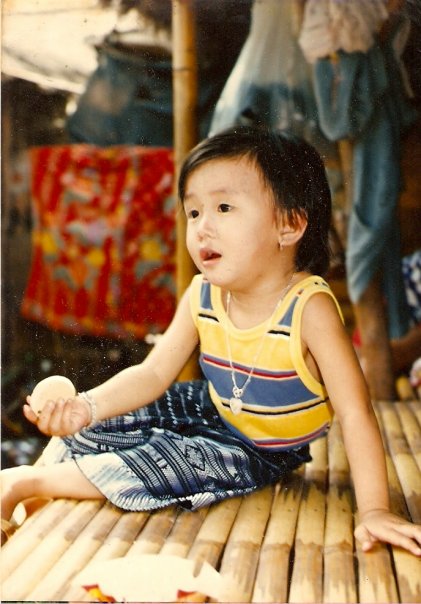
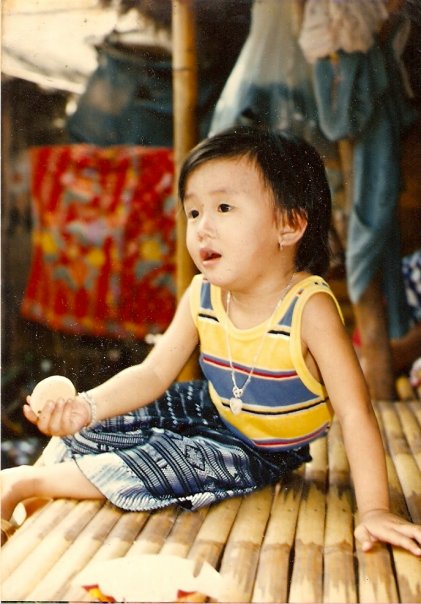
But the one thing I felt wholly unprepared for was plain, old heartache. After ending a nine-year relationship and breaking off an engagement, I felt utterly lost. I found myself drawn to the things that comforted me as a child, the same things that helped me when I was physically, emotionally, and sexually abused. I drew to writing. I drew to poetry and music. I looked at photos of myself as a child—just to try and make sense of where I had come from, to try and ground myself in something.

I’m not someone that likes to feel weak or to ask anyone for anything, especially help, so I tried to look for my own remedies. I found this book by Rainer Maria Rilke that served as my lifeline. Every page seemed to emanate with understanding and compassion. He seemed to speak to me, to speak right to me, and I felt so grateful to know that someone had felt the same things that I was feeling at the moment.

I would highly recommend this book. Except for a few key people who helped me through this time in my life, this book was one of the things that kept me going. Below is one of the passages that really helped me. I hope it helps you too.

Letters to a Young Poet, Rainer Maria Rilke

I believe that almost all our sadnesses are moments of tension that we find paralyzing because we no longer hear our surprised feelings living. Because we are alone with the alien thing that has entered into our self; because everything intimate and accustomed is for an instant taken away; because we stand in the middle of a transition where we cannot remain standing. For this reason the sadness too passes: the new thing in us, the added thing, has entered into our heart, has gone into its inmost chamber and is not even there anymore,–is already in our blood. And we do not learn what it was. We could easily be made to believe that nothing has happened, and yet we have changed, as a house changes into which a guest has entered. We cannot say who has come, perhaps we shall never know, but many signs indicate that the future enters into us in this way in order to transform itself in us long before it happens. And this is why it is so important to be lonely and attentive when one is sad: because the apparently uneventful and stark moment at which our future sets foot in us is so much closer to life than that other noisy and fortuitous point of time at which it happens to us as if from outside. The more still, more patient and more open we are when we are sad, so much the deeper and so much the more unswervingly does the new go into us, so much the better do we make it ours, so much the more will it be our destiny, and when on some later day it “happens” (that is, steps forth out of us to others), we shall feel in our inmost selves akin and near to it. And that is necessary. It is necessary–and toward this our development will move gradually–that nothing strange should befall us, but only that which has long belonged to us.

the body shudders and clutches what it must release

So I’m turning 28 on Thursday, and it made me think of the past. Sometimes, I feel like I’m a 65-year-old woman stuck in a 20-something’s body. Maybe all this introspection makes me feel old. Oddly enough, I’ve never felt more young. Well, that’s a lie. I think I felt the youngest a few years back. I’d say from 25-26. Everything seemed possible, but in a really frightening way. Now things are still possible, but I don’t feel like hyperventilating every time I think about the future.

Sometimes I wonder if it ever ends: this uncertainty, but I guess that’s the beauty of it all. Nothing is really certain. I know I’ve learned a lot in the past three years, and I can look back with rose-coloured glasses at everything that’s happened, but sometimes I wonder if I can ever really remember those moments, really capture them. They’re so skewed now, and everything that I thought was so ugly at the time, is now so beautiful, and everything that meant so much at the time, people that meant so much to me, they barely mean anything at all.

I think we all have this desire to go back in time and tell ourselves something, anything, that would help, but that’s not the way things are. I think the real beauty of it all, is in the not knowing, not knowing what’s going to happen next, and not really understanding what has come to pass.

First Gestures, Julia Spicher Kasdorf

Among the first we learn is good-bye,
your tiny wrist between Dad’s forefinger
and thumb forced to wave bye-bye to Mom,
whose hand sails brightly behind a windshield.
Then it’s done to make us follow:
in a crowded mall, a woman waves, “Bye,
we’re leaving,” and her son stands firm
sobbing, until at last he runs after her,
among shoppers drifting like sharks
who must drag their great hulks
underwater, even in sleep, or drown.

Living, we cover vast territories;
imagine your life drawn on a map–
a scribble on the town where you grew up,
each bus trip traced between school
and home, or a clean line across the sea
to a place you flew once. Think of the time
and things we accumulate, all the while growing
more conscious of losing and leaving. Aging,
our bodies collect wrinkles and scars
for each place the world would not give
under our weight. Our thoughts get laced
with strange aches, sweet as the final chord
that hangs in a guitar’s blond torso.

Think how a particular ridge of hills
from a summer of your childhood grows
in significance, or one hour of light–
late afternoon, say, when thick sun flings
the shadow of Virginia creeper vines
across the wall of a tiny, white room
where a girl makes love for the first time.
Its leaves tremble like small hands
against the screen while she weeps
in the arms of her bewildered lover.
She’s too young to see that as we gather
losses, we may also grow in love;
as in passion, the body shudders
and clutches what it must release.

from the heart in exile

Whenever I’m about to embark upon a journey, or enter a new stage in my life, I unconsciously (or maybe consciously) seek out art that’s able to describe what I’m feeling. I remember hearing The XX two years ago (I mean, three years ago, my, how time flies), and it hooked me right from the intro. Oddly enough, Intro is my favourite out of the eleven songs from their debut album, xx.

So, I’m headed to California for a much needed vacay. It’s been a long few years. I know everyone says that, but it’s true! Haha. I’m off for a week in Cali, which will culminate at Coachella. I’ve been trying to listen to musicians that will be playing during the festival (The XX won’t be one of them, unfortunately), and I put some examples at the bottom of this post. (Although, I’ve been listening to The Black Keys and Florence + the Machine for years, M. Ward is new for me.) I’m stoked to add new music to my listening reportoire.

Tonight’s the last night for the first weekend of festivities. I bet the festival-goers don’t want to leave, which I think will be the case for me. I hope they’re having the time of their lives. I really can’t wait to be a part of this magical musical experience! And I can’t wait to see what California has in store for me.

Here I go! But first, what to pack…

The Word, Tony Hoagland

Down near the bottom
of the crossed-out list
of things you have to do today,

between “green thread”
and “broccoli” you find
that you have penciled “sunlight.”

Resting on the page, the word
is as beautiful, it touches you
as if you had a friend

and sunlight were a present
he had sent you from some place distant
as this morning — to cheer you up,

and to remind you that,
among your duties, pleasure
is a thing,

that also needs accomplishing
Do you remember?
that time and light are kinds

of love, and love
is no less practical
than a coffee grinder

or a safe spare tire?
Tomorrow you may be utterly
without a clue

but today you get a telegram,
from the heart in exile
proclaiming that the kingdom

still exists,
the king and queen alive,
still speaking to their children,

— to anyone among them
who can find the time,
to sit out in the sun and listen.

(poem from The Wondering Minstrel‘s blog)